Early identification shapes the entire national pathway.
It determines who gets access to elite environments, who receives accelerated support, and who is seen again next season. In other words, Talent ID doesn’t just select players for today. It shapes the pipeline for tomorrow.
Yet in many federations, identification still runs on fragmented inputs:
- Scouting notes captured in different formats by region
- Testing data stored separately from match context
- Limited visibility into a player’s development history
- Inconsistent criteria that change by coach, selector, or environment
The result is predictable.
Selection becomes subjective. Opportunity becomes uneven. And late developers are missed—not because they lack potential, but because the system can’t see them clearly enough, early enough.
The Problem Isn’t Scouting. It’s Fragmentation.
Most federations have talented people in place: scouts, selectors, coaches, and performance staff.
The challenge is that those people are often working with partial information.
When data is disconnected:
- Evaluations are influenced by personal judgment more than shared criteria
- Bias toward certain regions, clubs, or competitions becomes harder to avoid
- Players are assessed in snapshots instead of over time
- Context is missing (maturity, exposure, availability, development environment)
- Selection decisions are difficult to explain—and harder to improve
This is how a pathway becomes dependent on who is seen, not who is ready.
What Modern Talent ID Looks Like for Federations
Forward-looking federations are redefining identification as a structured, evidence-led process.
Not because they want to remove human expertise, but because they want to support it with reliable context.
A modern federation Talent ID model is built on five principles:
1. Standardized criteria across regions
Selectors can’t fairly compare players if the criteria differ by region or evaluator.
Modern systems provide shared templates, scoring frameworks, and definitions—so assessments are consistent and transparent, regardless of where a player is observed.
2. Testing data captured into the player profile
When physical testing and maturation information sits outside the pathway, it rarely informs selection in a meaningful way.
Federations are increasingly connecting test results directly to player profiles so readiness can be assessed with greater context—not just reputation or highlight moments.
3. Benchmarking by age, position, and region
Talent is relative. A standout at one stage might be average at another.
By benchmarking players within comparable cohorts—age band, position group, region, competition level—federations can identify emerging talent earlier and reduce reliance on intuition alone.
4. Longitudinal visibility across seasons
One tournament is not a development story.
The most reliable identification systems track progression over multiple seasons, so selectors can:
- Spot late developers
- Validate whether improvement is sustained
- Understand what environments are accelerating growth
- Reduce the risk of “one-off” selection decisions
5. Complete selection context, including availability
Readiness is more than performance.
Modern Talent ID connects selection insight with key context such as:
- Training and match exposure
- Wellness and availability
- Injury history and return to play status
- Development milestones and assessments
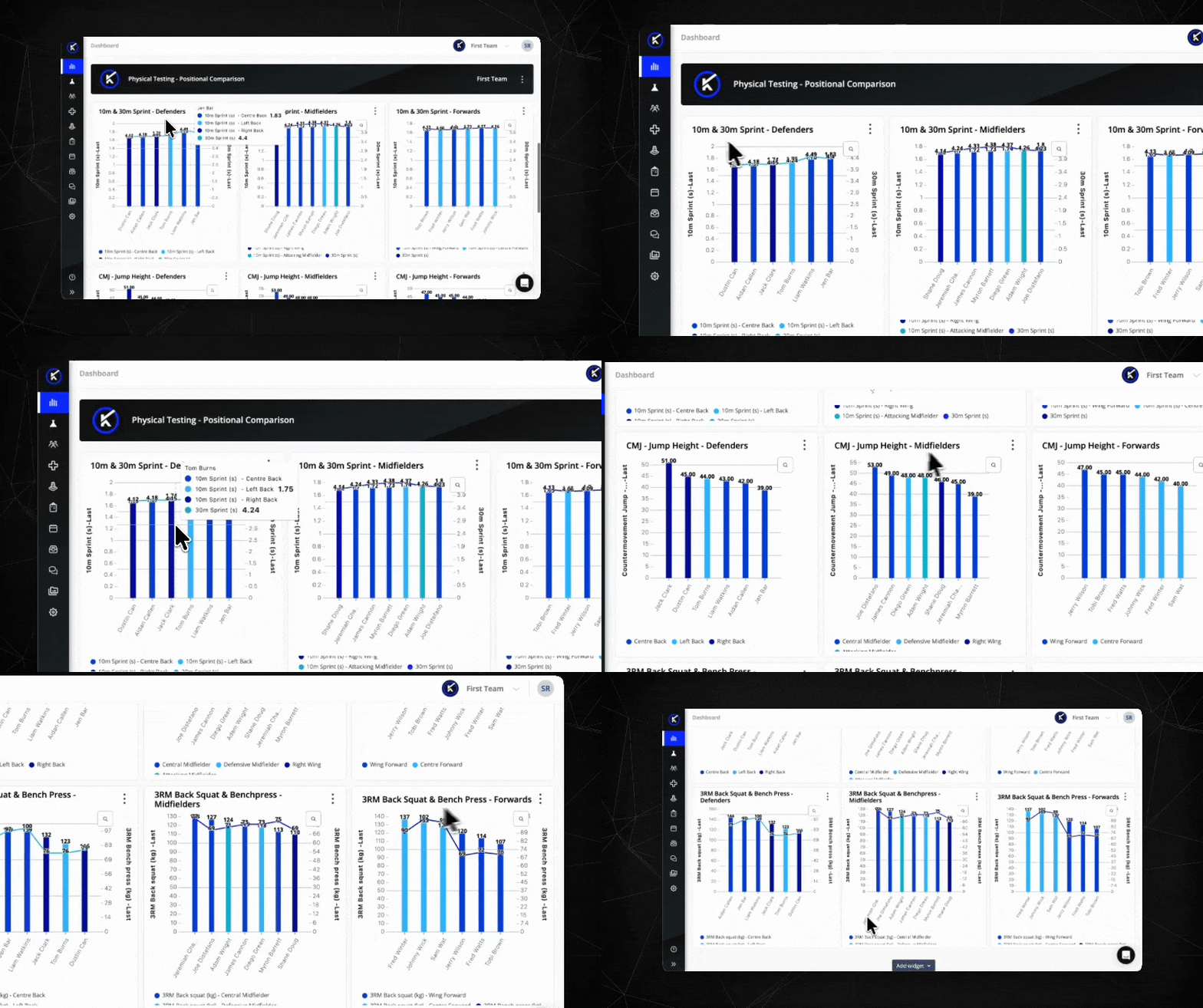
This turns selection into a decision based on evidence, not incomplete visibility.
What This Enables at a Federation Level
When identification becomes evidence-led and consistent, the impact extends beyond selection weekend.
Federations can:
- Improve fairness by applying shared criteria across regions
- Increase accuracy by seeing players in context and over time
- Reduce bias through comparable benchmarks and structured evaluations
- Strengthen pathway planning by understanding depth and progression
- Build trust with clubs, regions, and athletes by making decisions easier to explain
This is how Talent ID becomes more reliable, equitable, and predictive.
Evidence-Led Selection in Practice
For many federations, delivering this level of consistency requires more than policy—it requires shared infrastructure.
Operations & Pathway Management, an Integrated Solution within iP: Intelligence Platform, provides the connected foundation that allows scouting insight, testing data, competition exposure, and availability context to live together—so selectors can evaluate players within the full pathway, not in isolation.
To support this approach, federations are adopting workflows that unify:
- Scouting assessments
- Testing and maturation data
- Match exposure and competition participation
- Progression history over time
- Availability and welfare context
So selectors can move from “who impressed recently” to “who is progressing reliably, and why.”