Federations and leagues have invested heavily in building their competition, development, and governance ecosystems. Pathway frameworks are evolving. Coaching education is expanding. Data collection is accelerating across every level of the game.
Yet despite this momentum, the underlying operational and development infrastructure remains fragmented. Registration lives in one system. Player evaluations in another. Matchday information in a third. Welfare and medical history often disappear the moment a player changes clubs.
This fragmentation isn’t just inefficient—it undermines national development. Talent slips through the cracks not because players lack potential, but because the structure is too disconnected to provide consistent visibility or accountability. And in a modern high-performance environment where development has real competitive and commercial impact, fragmentation doesn’t just slow progress—it creates risk.
The problem isn’t only that pathways aren’t visible—it’s that operations, governance, development, and welfare are disconnected from one another. Without this connectivity, standards drift, decisions lack context, and progress becomes unpredictable—and costly.
When these systems are connected and visible, talent accelerates, standards are strengthened and enforced, and the wider ecosystem becomes more powerful and resilient—competitively, commercially, and operationally.
A Strategic Shift: From Running Games to Building Pathways
Historically, governance centered on administration: overseeing competitions, enforcing compliance, and managing eligibility. Important work—but limited in its long-term impact.
Today, leading organizations are broadening that scope. They’re aligning governance with performance goals and linking:
- Competition operations with player development
- Club registration with coaching oversight
- Matchday information with pathway progression
- Welfare standards with readiness tracking
They’re also ensuring that player information follows the athlete—from grassroots clubs to regional programs to national teams—eliminating the club vs. country disconnect that has long led to overload, preventable injury, and gaps in player welfare and performance history.
This shift isn’t cosmetic. It’s structural—and essential.
The federations and leagues making this transition are not only improving development outcomes; they’re strengthening the commercial engine of their domestic game. Clearer pathways create more valuable players, stronger club decision-making, and more compelling competitions.
Introducing Operations & Pathway Management
Operations & Pathway Management is an Integrated Solution within iP: Intelligence Platform, bringing together key capabilities from League Operations and Coaching & Development. It is not a new standalone Solution, but an integrated offering explicitly designed for federations, leagues, and governing bodies.
It’s built for organizations responsible for governance, operational oversight, and player progression—and it’s already helping forward-looking federations and leagues operate with greater clarity, consistency, and confidence.
It provides a single, connected foundation—eliminating silos, reducing administrative burden, and giving every stakeholder access to a live, evidence-based view of the ecosystem spanning clubs, competitions, and development pathways.
Modernization doesn’t have to increase operational burden. For many organizations, it begins with consolidating fragmented systems into a single, connected environment—reducing complexity, elevating capability, and strengthening long-term sustainability.
Instead of stitching together disconnected tools, federations, leagues, and governing bodies operate on a single integrated foundation—built to support growth, governance, and long-term development.
What It Delivers: Core Capability Areas
Operations & Pathway Management unifies governance, match operations, player development, and athlete welfare into one connected ecosystem. Together, these four areas bring together a broad set of capabilities that create consistency, visibility, and accountability across every level of the game. They form the foundation for how Operations & Pathway Management delivers alignment, oversight, and connected insight —and how it drives competitive strength and long-term commercial growth in a rapidly evolving landscape.
1. Operational Governance
Strengthen governance and operational integrity with connected, compliant workflows:
- Digital player/coach registration and centralized participant records
- Eligibility checks for age, certification, and suspensions
- Workflow approvals and audit trails for transparency
- Automated fixture oversight and shared calendars
- Real-time dashboards across fixtures, lineups, and compliance status
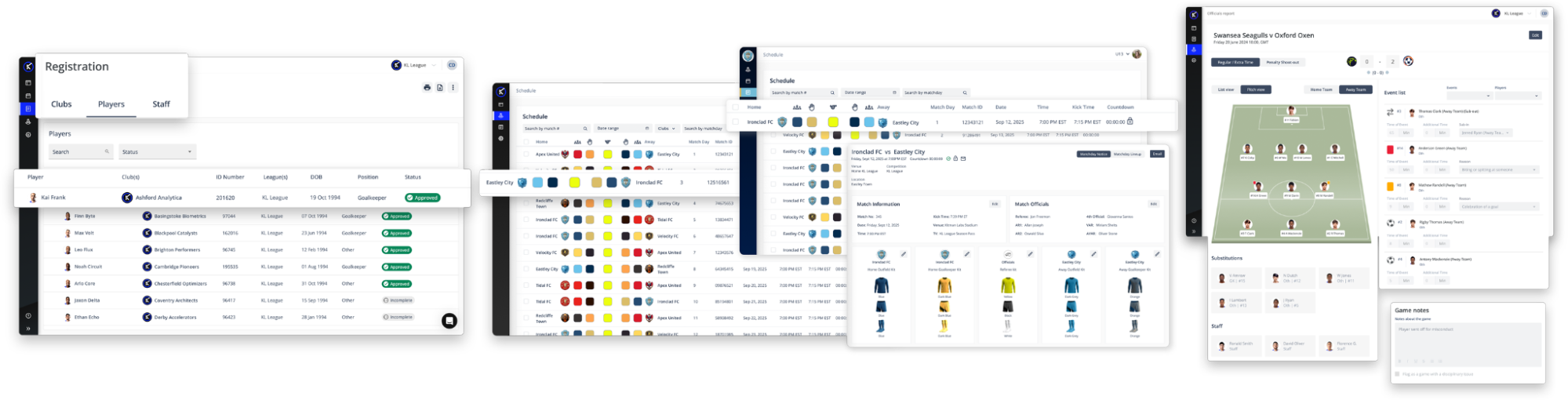
Strong governance frameworks don’t just ensure compliance—they build the trust, consistency, and operational integrity that every modern competition and development environment depends on.
2. League-Wide Match Management
Deliver smooth, professional matchday execution and season-wide visibility:
- Lineup submissions with eligibility validation
- Match official assignments, notices, and reporting
- Live scoring and match event logging
- Disciplinary tracking and case management
- Player movement tracking with full audit trails—ensuring that every transfer, loan, and trialist interaction remains visible and accountable across the pathway.
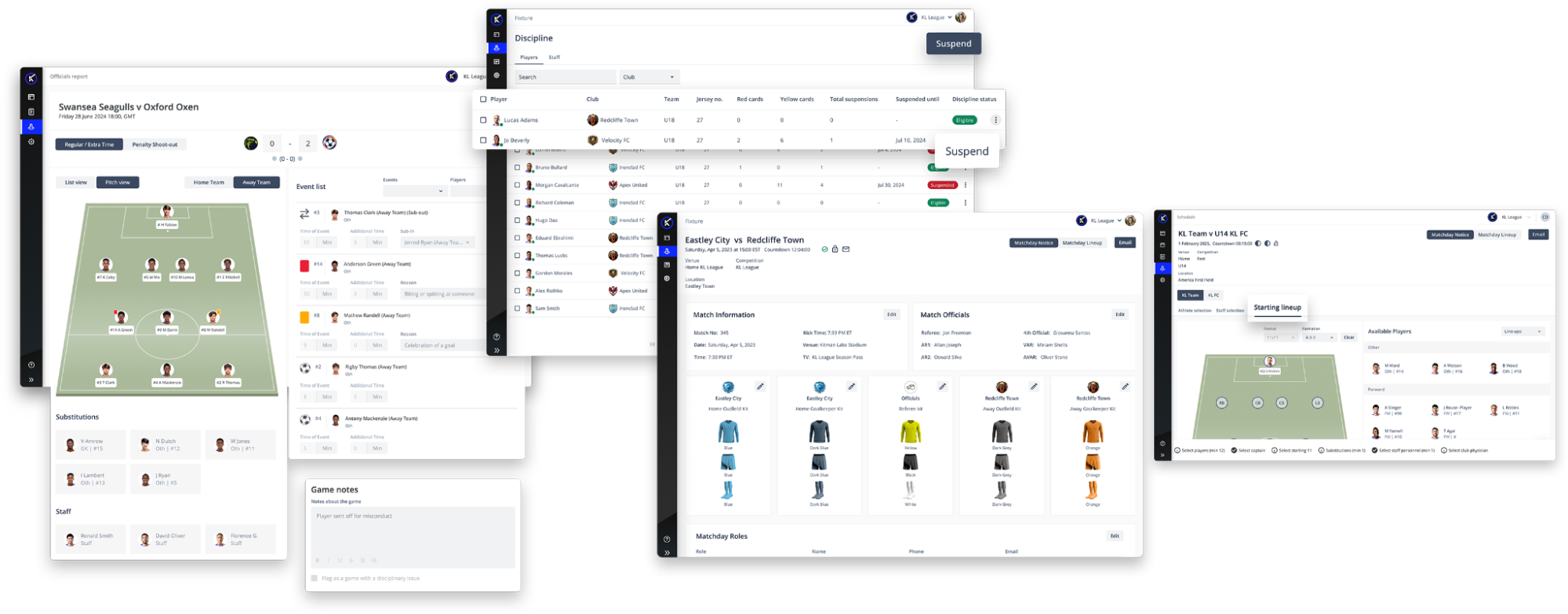
This level of visibility reduces administrative risk, strengthens competitive integrity, and provides the operational consistency required for commercial growth.
3. Player Development & Coaching Alignment
Systemize and monitor how players are developed across clubs:
- Coaching curriculum and principles of play by age and phase
- Session planning, drill libraries, and alignment to objectives
- Player profiles with exposure tracking and assessments
- 360° Individual Development Plans (IDP) and cohort benchmarking
- Growth, maturation, and long-term development trend analysis
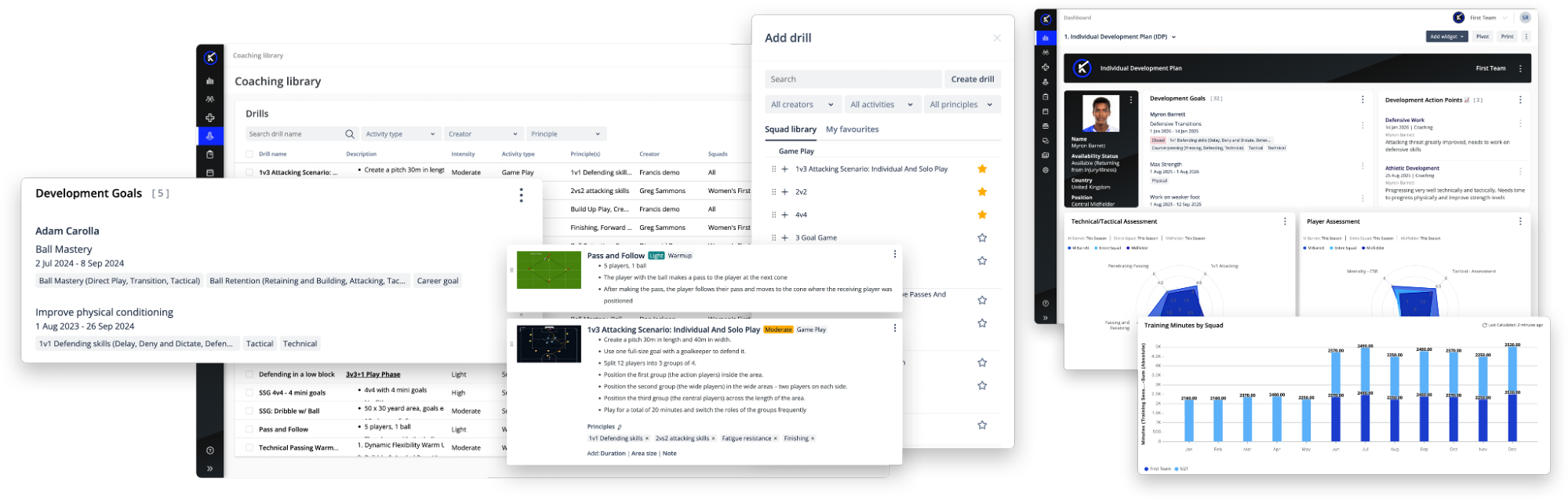
Consistent development frameworks and connected pathways create stronger national pipelines, increase player visibility, and ultimately contribute to higher player valuations and reinvestment across the ecosystem.
4. Player Welfare & Performance Insight
Support athlete welfare while maintaining sustainable development systems:
- Wellness monitoring and workload visibility
- Injury records and return to play oversight
- Readiness status and training availability
- Development reviews with player and coach inputs
- RAG indicators to flag athletes who may need additional support
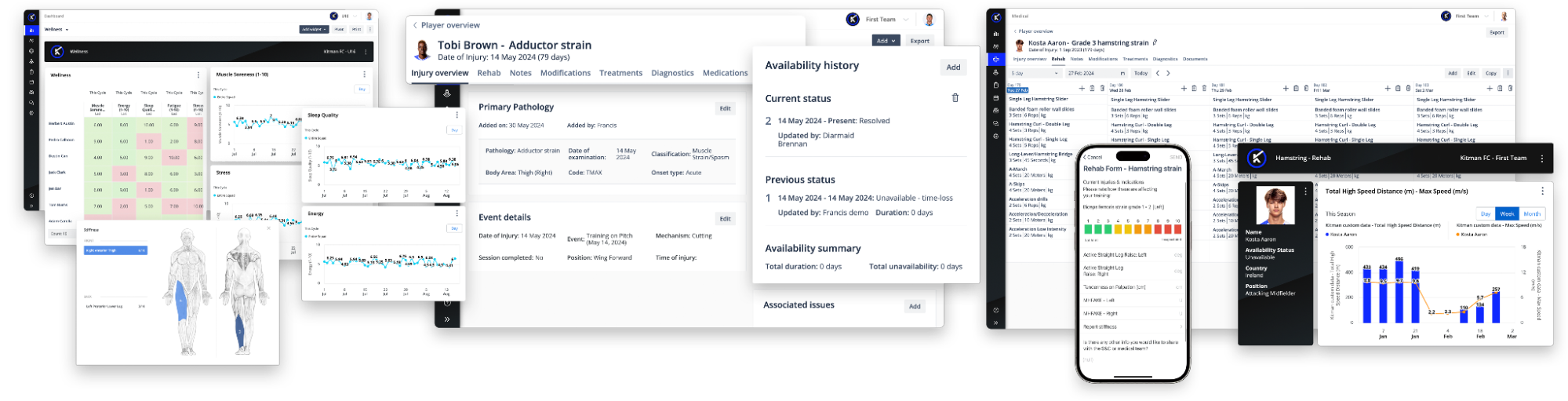
A connected approach to welfare doesn’t just protect athletes—it protects the long-term competitiveness and credibility of the ecosystem. Strong welfare standards attract talent, increase trust from clubs, and strengthen commercial positioning.
Built for Federations. Ready for Leagues.
Every governing body faces different challenges. Some oversee sprawling national ecosystems. Others manage tight-knit regional leagues. But the need is the same:
- Consistency. Shared frameworks across clubs.
- Visibility. Real-time insight into progression and participation.
- Accountability. Clear standards, measurable outcomes.
Operations & Pathway Management supports all three.
It scales to fit your structure. It connects to your existing tools. And it empowers every stakeholder—from technical directors to competition managers—to work from a single source of truth.
It also gives leadership the oversight they’ve never had: live,cross-system visibility into standards, participation, welfare, and development impact—all in one place.
For executives, this visibility is not just operational. It’s strategic. A more connected operating model supports sustainable growth, strengthens competitive position, attracts investment, enables smarter resource allocation, and enhances the commercial appeal of competitions.
The Connected Future Starts Now
Disconnected systems can run a federation or league. They cannot grow it. And they certainly cannot keep pace with nations modernizing their pathways, infrastructure, and development pipelines.
To build a modern, competitive competition and development environment, federations and leagues need infrastructure that unites governance with development. Administration with accountability. Compliance with care.
Operations & Pathway Management is that infrastructure. It’s how the most progressive organizations are aligning their systems to their ambitions.
Modernization isn’t optional. The gap between connected and disconnected operating models widens every season—competitively, financially, and developmentally. The organizations acting now will shape the future of their national game; those who don’t will be shaped by it.
The future isn’t just about managing the game. It’s about transforming it. Ready to modernize? Contact us to schedule a demo.