Every NFL Draft brings a flood of opinions.
Some prospects rise on buzz. Others fall on perception. And somewhere between the Combine, pro days, mock drafts, and team needs, it becomes harder to separate long-term potential from short-term hype.
That’s where a different lens can help.
Last year, we used AI to evaluate NFL Draft prospects based on college production, Combine performance, and physical characteristics. The goal wasn’t to predict who would have the flashiest rookie season. It was to identify which players had the strongest probability of becoming meaningful long-term NFL contributors.
One season isn’t enough to fully judge a prospect or validate a model. But a rookie year can offer an early signal. Looking back at the 2025 class, several of the players our model rated highly have already started to show why they stood out.
What Our Model Is Designed to Predict
Draft analysis often focuses on immediate impact. Our model doesn’t.
It looks for a combination of traits that have historically been associated with longer-term NFL success: efficiency, production, physical profile, and versatility. That means the model may align with consensus in some cases, and in others, it surfaces players whose underlying profiles are stronger than their draft positions suggest.
The early returns from the 2025 class offer a useful reminder of why that distinction matters.
Running Backs: Strong Signals at the Top and Beyond
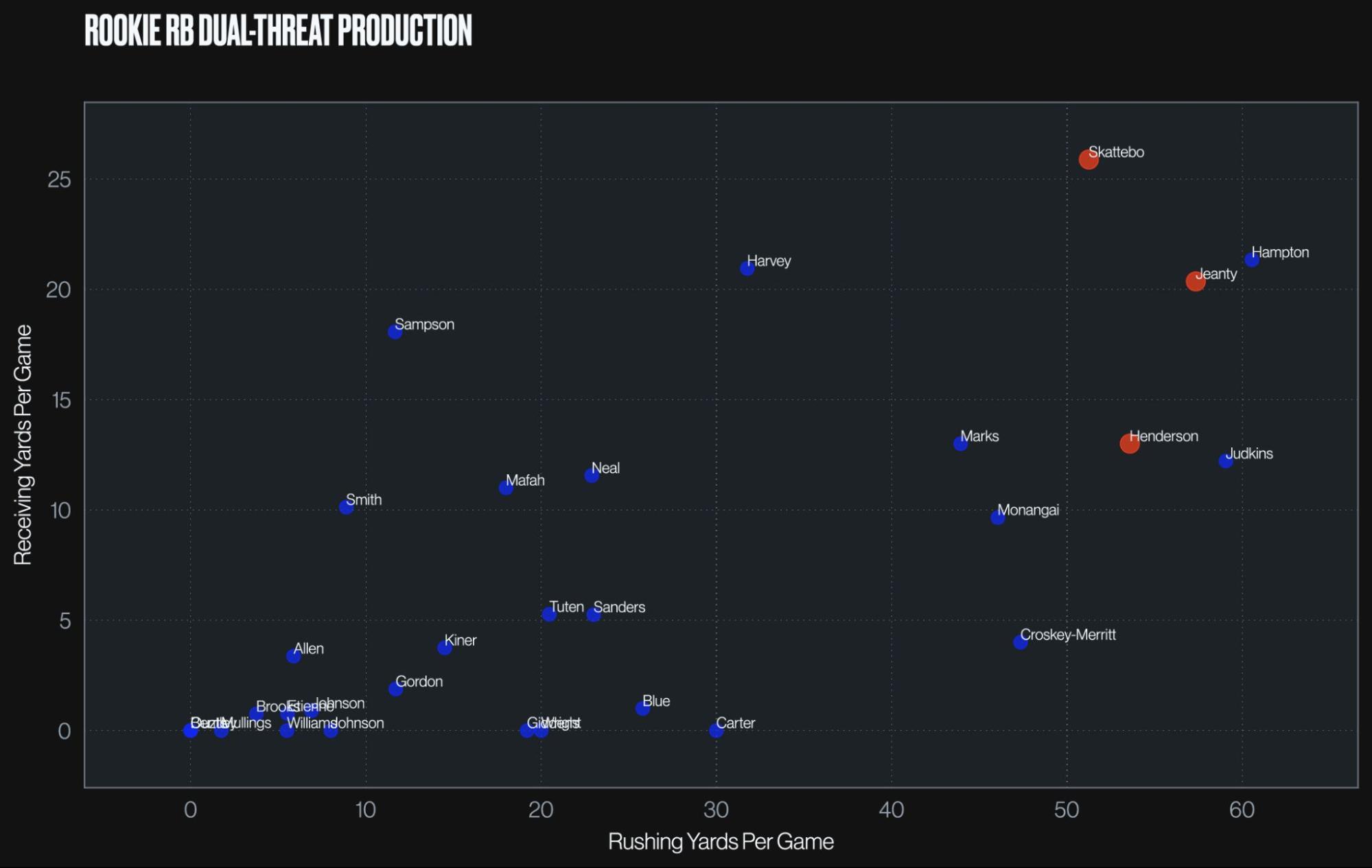
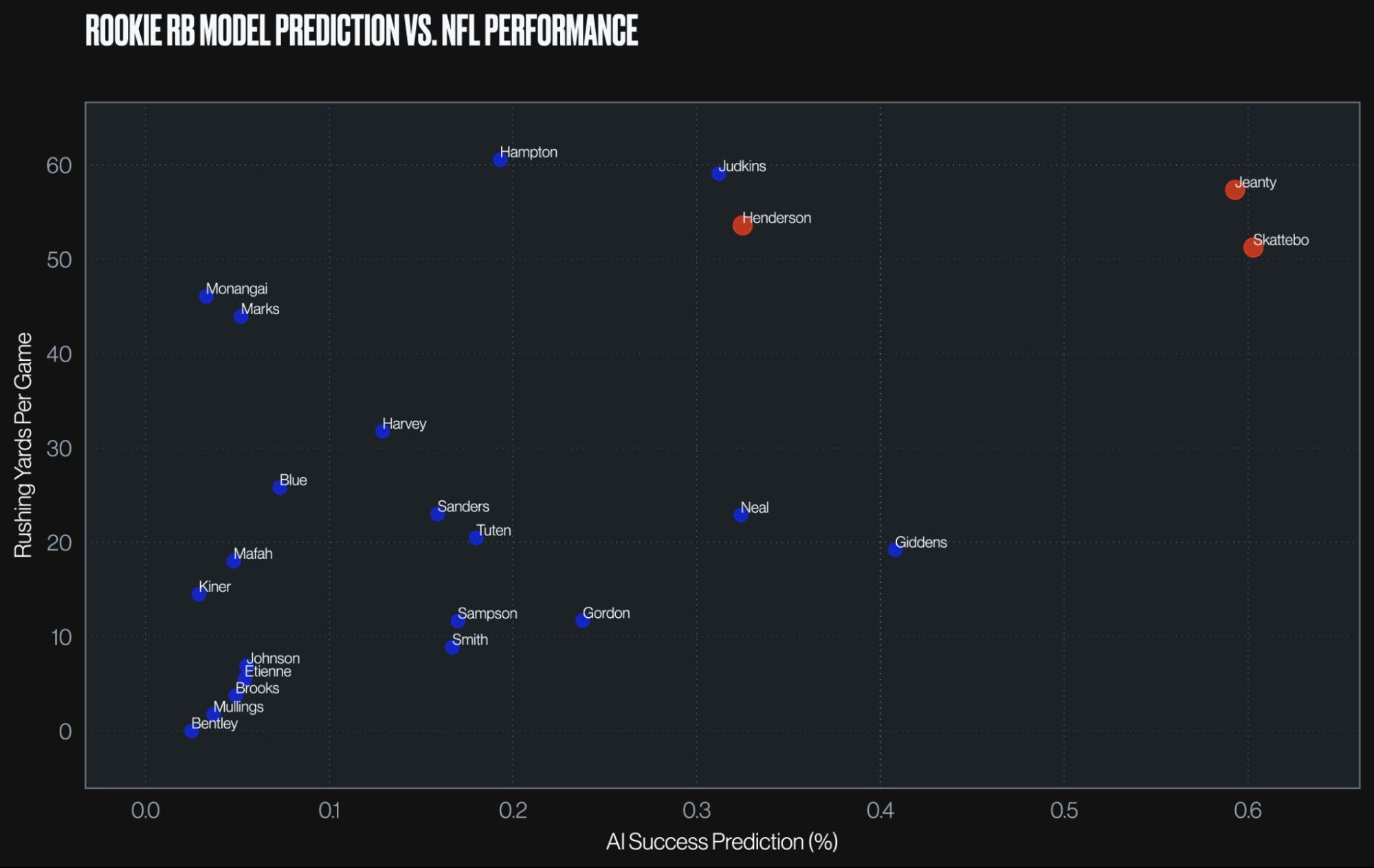
The 2025 running back class gave the model some of its clearest early validation, both among top selections and in the later rounds where value is harder to find. That early validation also shows up in the chart, with Skattebo, Jeanty, and Henderson standing out among the more productive rookie backs in both rushing and receiving output.
Cam Skattebo, Arizona State
Drafted: 4th Round (105th Overall) | AI Success Probability: 60%
Skattebo was the highest-rated running back in our model, even though he came off the board in the fourth round. That gap between model score and draft position made him one of the clearest examples of the model identifying value ahead of consensus.
His college profile stood out for all the right reasons: 416 receiving yards per season, proven dual-threat production, and a 219-pound frame that tends to translate well at the next level. For his draft range, his success probability was nearly triple the average.
His rookie season gave those signals early support. Before an ankle injury after Week 8 cut his year short, Skattebo ranked in the top five among rookie running backs in rushing yards per game and led the entire rookie RB class in receiving yards per game. His three-touchdown game against Philadelphia was one of the standout moments of his rookie year. For a fourth-round pick, it was exactly the kind of early return that makes this kind of analysis valuable.
Ashton Jeanty, Boise State
Drafted: 1st Round (6th Overall) | AI Success Probability: 59%
Not every strong model result has to be a sleeper.
Jeanty was widely viewed as the top running back in the class, and our model agreed. His profile combined elite production, 16 rushing touchdowns per season, and a solid 211-pound frame. The conventional view and the data pointed in the same direction.
His NFL debut backed that up. Jeanty led all rookie running backs in rushing yards and carries, led the class in receptions, finished second in receiving yards, and totaled 10 touchdowns. In this case, the model wasn’t surfacing an overlooked name. It was confirming that the consensus was grounded in the right indicators.
TreVeyon Henderson, Ohio State
Drafted: 2nd Round (38th Overall) | AI Success Probability: 32%
Henderson was a more nuanced evaluation.
Our model slightly penalized his lighter 202-pound build, but his production and athletic profile were still strong enough to make him a player worth watching closely. That balance matters. The model isn’t just about rankings. It is also about understanding the traits behind them.
That upside showed up quickly. Henderson led all rookie running backs in rushing touchdowns, finished second in rushing yards, posted the highest rushing EPA of any rookie back, and ranked second in yards per carry at 5.06. He also contributed as a receiver, finishing third among rookie RBs in receiving yards.
Quarterbacks: Why Dual-Threat Profiles Continue to Matter
Quarterback is the hardest position to project, which makes early signals especially valuable.
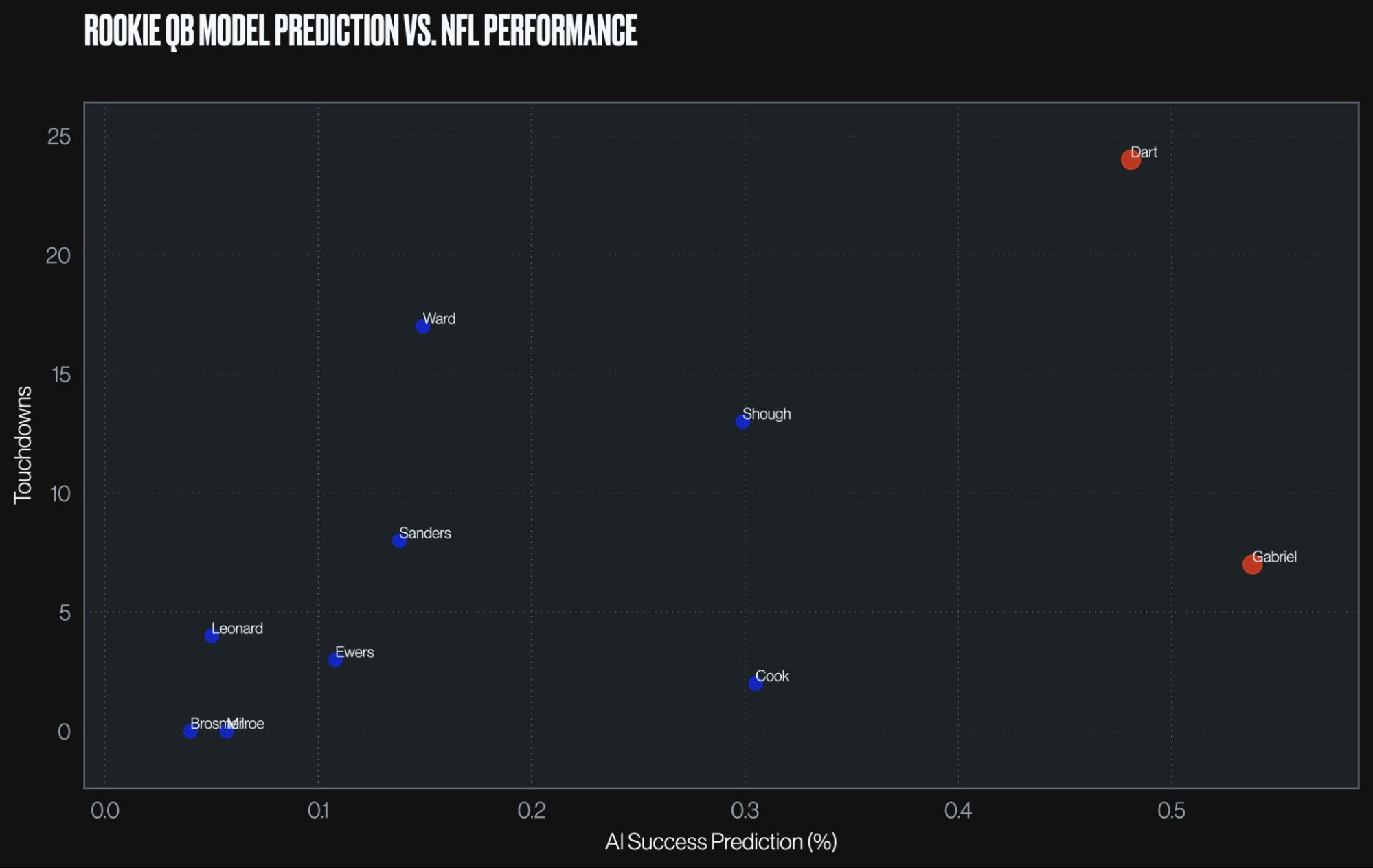
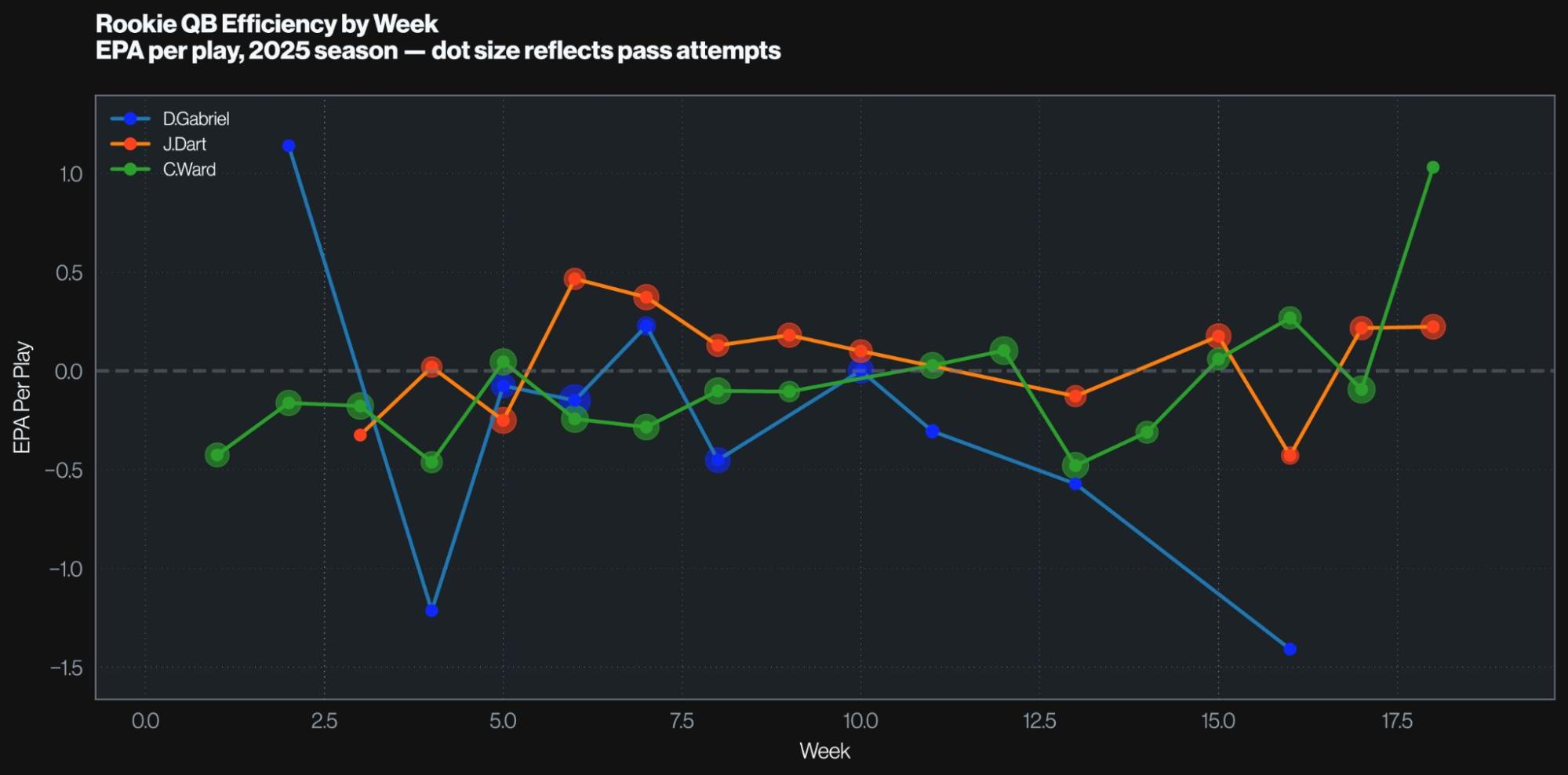
In the 2025 class, our model was particularly drawn to quarterbacks who paired passing efficiency with meaningful rushing value. That combination raises a prospect’s floor and creates more pathways to long-term success. That pattern also shows up in the charts, particularly in how Dart separates from the rest of the rookie quarterback group in touchdown production and sustained efficiency stretches.
Jaxson Dart, Ole Miss
Drafted: 1st Round (25th Overall, 2nd QB Selected) | AI Success Probability: 48%
The model liked Dart even while docking points for missing Combine data. His dual-threat profile, averaging 2,995 passing yards and 385 rushing yards per season in college, gave him a profile that pure pocket passers in his range couldn’t match.
His rookie season offered one of the clearest early validations of that profile. Dart tied for the most passing touchdowns among rookie quarterbacks with 15 while playing three fewer games than his closest competitor. He led all rookie QBs in rushing yards by a wide margin and finished with 24 total touchdowns, the most among all rookies. The traits our model valued showed up quickly and clearly.
Dillon Gabriel, Oregon
Drafted: 3rd Round (94th Overall) | AI Success Probability: 54%
Gabriel was our model’s top-rated quarterback in the class, despite being selected in the third round when we projected him as a fifth-round pick. His college passing efficiency, including a 65.4% completion rate and 8.77 yards per attempt, was a key driver of that ranking.
His first NFL season with Cleveland wasn’t without challenges, but it was encouraging. Gabriel appeared in 10 games, started six, and threw for 937 yards and seven touchdowns. His efficiency dipped in the pros, which is worth monitoring, but earning meaningful starts as a third-round rookie quarterback is a notable early signal.
Seth Henigan, Memphis
Draft Status: Undrafted | AI Success Probability: 51%
Henigan remains the most speculative name in this group, and also a good example of how the model can surface players worth monitoring beyond draft weekend.
He went undrafted and has yet to appear in a regular season game, but the model still assigned him a 51% success probability based on his passing production, rushing value, and strong four-year statistical profile. That’s the same projection we assigned Brock Purdy ahead of the 2022 draft. It doesn’t guarantee anything. It reflects the kind of résumé the model has historically found meaningful, even when the draft process doesn’t.
Wide Receivers: Strong Indicators Still Travel
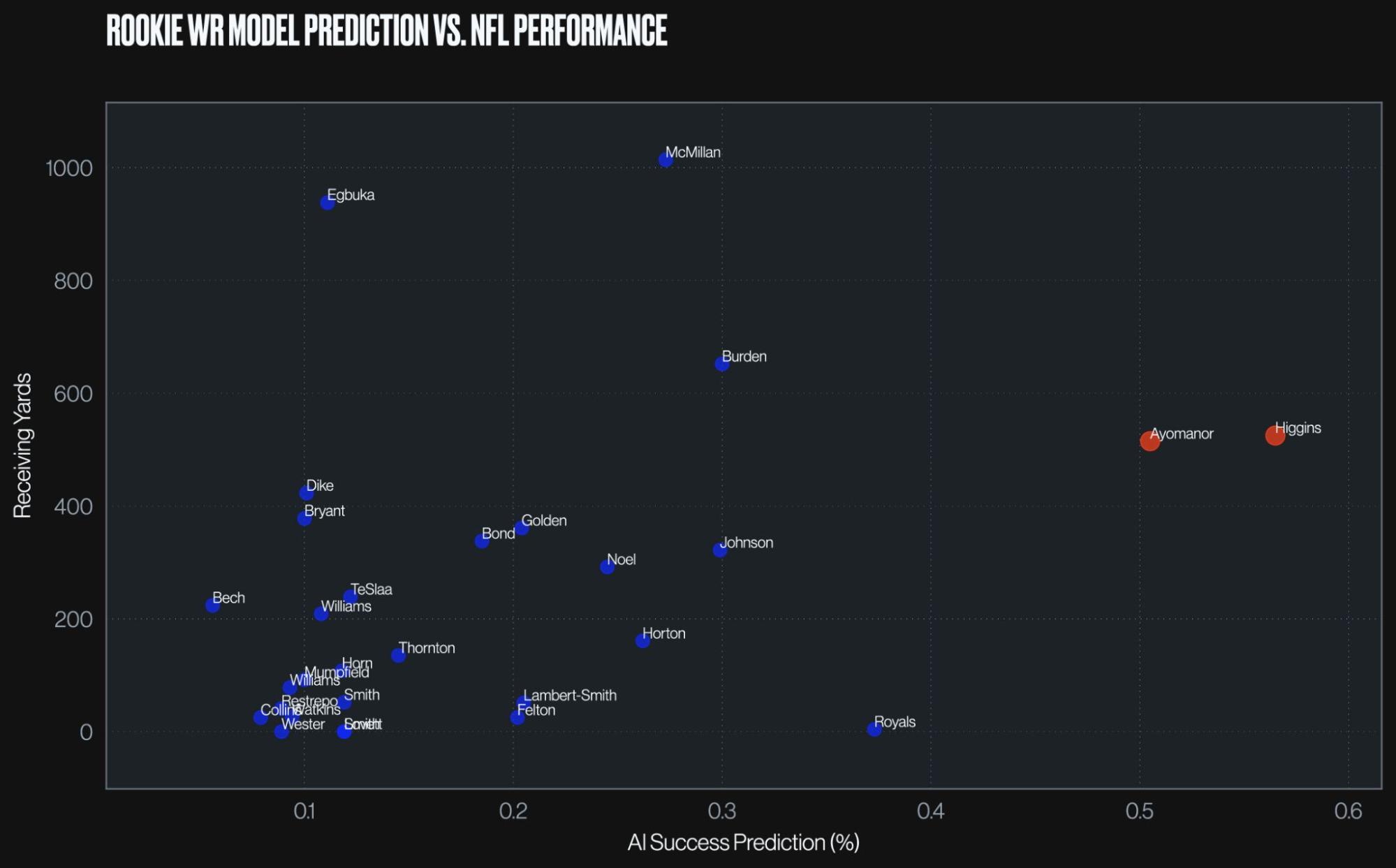
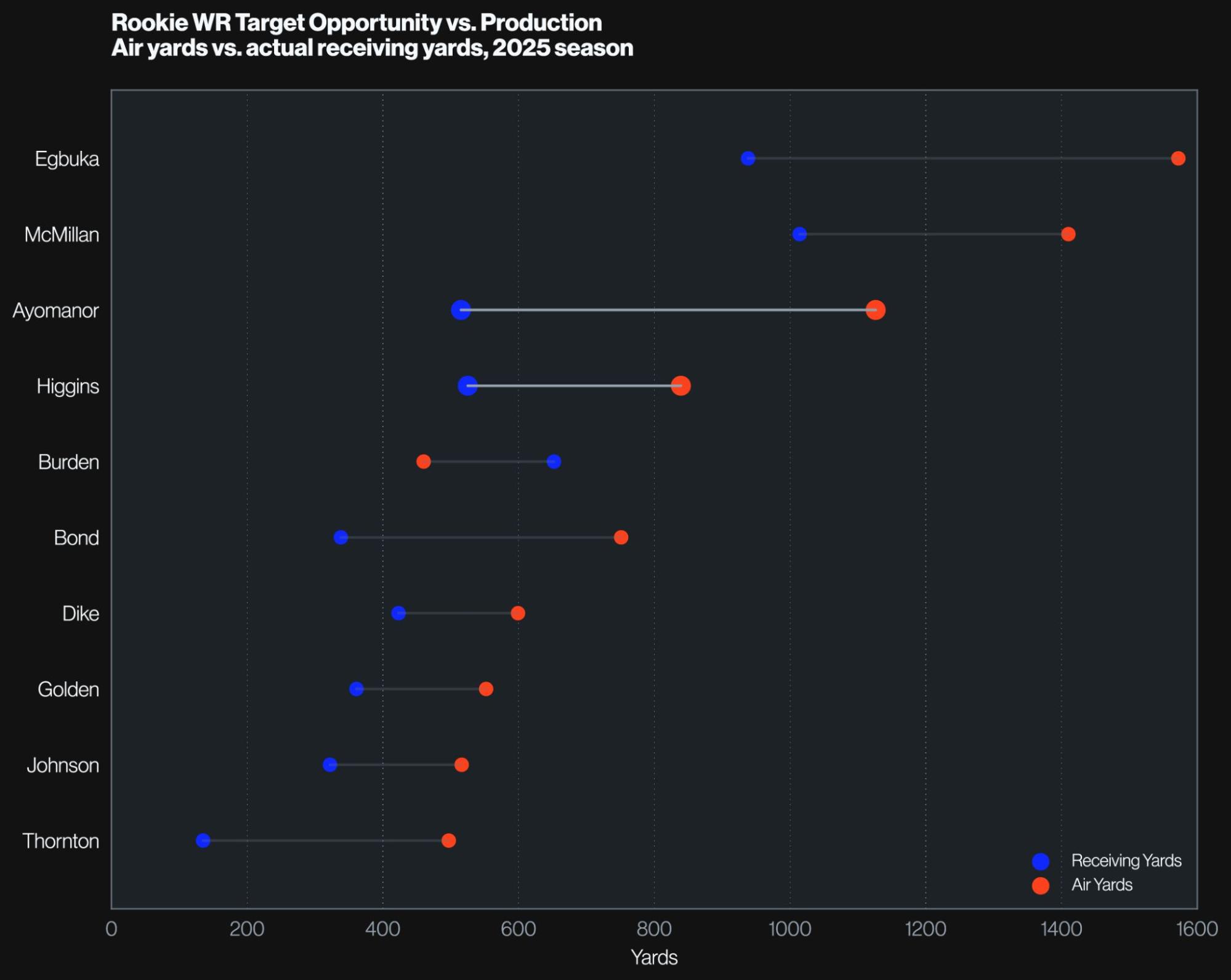
Wide receiver success can be shaped by scheme and opportunity, but strong underlying traits still matter. Two of the model’s top calls at the position delivered encouraging early returns. That story also comes through in the charts, with Higgins and Ayomanor standing out among the stronger rookie receivers by production and target opportunity.
Jayden Higgins, Iowa State
Drafted: 2nd Round (34th Overall) | AI Success Probability: 56%
The model’s top-rated wide receiver in the class backed it up with a strong debut. Higgins entered the draft with a compelling combination of consistent production, averaging 974 receiving yards and 8.3 touchdowns per season, along with a standout Combine profile.
In Year 1, Higgins tied for second in receiving touchdowns among rookie WRs with six and ranked in the top five in receiving yards with 525. That’s a strong start for a player the model viewed as one of the best receiving bets in the class.
Elic Ayomanor, Stanford
Drafted: 4th Round | AI Success Probability: 50%
Ayomanor was one of the bigger slides of draft day, projected as a second-round pick before falling to the fourth. The model held its ground at 50%, pointing to his downfield production, elite 127-inch broad jump, and physical frame as traits that reliably translate.
His early NFL usage backed that up. Ayomanor finished top five among rookie WRs in receiving yards with 515 and ranked top three in receiving air yards with 1,126. That kind of air-yard total suggests more than opportunity. It points to a receiver being trusted in meaningful vertical situations. Draft-day reputation didn’t fully match the model’s view. Year 1 results did.
What These Results Tell Us Heading Into the 2026 NFL Draft
No model can fully predict the NFL. Draft outcomes will always be shaped by injuries, team fit, coaching, opportunity, and development. But that doesn’t reduce the value of modeling. It clarifies its role.
The early returns from the 2025 class suggest our model is doing what it was built to do: validate strong top-of-board prospects, identify later-round value before draft day, and surface players whose long-term profile may be stronger than conventional narratives suggest.
Cam Skattebo looked like a value call. Ashton Jeanty was a clear validation of consensus. TreVeyon Henderson showed that high-upside production can translate quickly. Jaxson Dart showed why dual-threat quarterbacks continue to stand out when projecting longer-term outcomes. Jayden Higgins and Elic Ayomanor reinforced that strong receiving indicators can translate quickly, even when draft positioning doesn’t fully reflect them.
That is what makes this kind of analysis useful ahead of the 2026 NFL Draft.
The goal isn’t to win the loudest draft-night debate. It’s to improve the process of identifying which prospects are built to last.
Not by replacing scouting. Not by oversimplifying development. But by helping teams and analysts better identify the combinations of performance, efficiency, physicality, and versatility that often matter most over time.
And in a process as uncertain as the NFL Draft, that kind of signal is worth paying attention to.
As teams look ahead to the 2026 NFL Draft, the opportunity is not just to evaluate more prospects. It is to evaluate them more clearly. That is where combining scouting expertise with data-driven analysis can create a real edge.
With those early signals in mind, we then turned to what the model sees in the 2026 class.