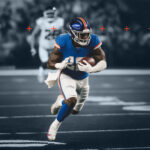
The NFL Draft is one of the hardest projection exercises in sport.
Teams invest heavily in scouting, Combine testing, film study, and interviews, yet long-term success remains difficult to predict. Across all positions, teams only get it right 19–27% of the time, with even first-round picks reaching sustained success just 56–69% of the time.
That uncertainty is exactly why another layer of analysis matters.
At Kitman Labs, we use AI trained on more than 15 years of NCAA performance and NFL Combine data to identify the statistical profiles most associated with NFL success. In this analysis, the model is focused on the combinations of production, efficiency, and physical traits that have historically translated to meaningful NFL contribution over multiple seasons.
With that lens, here is what the model sees in the 2026 class.
Quarterbacks: Production, Efficiency, and Dual-Threat Value
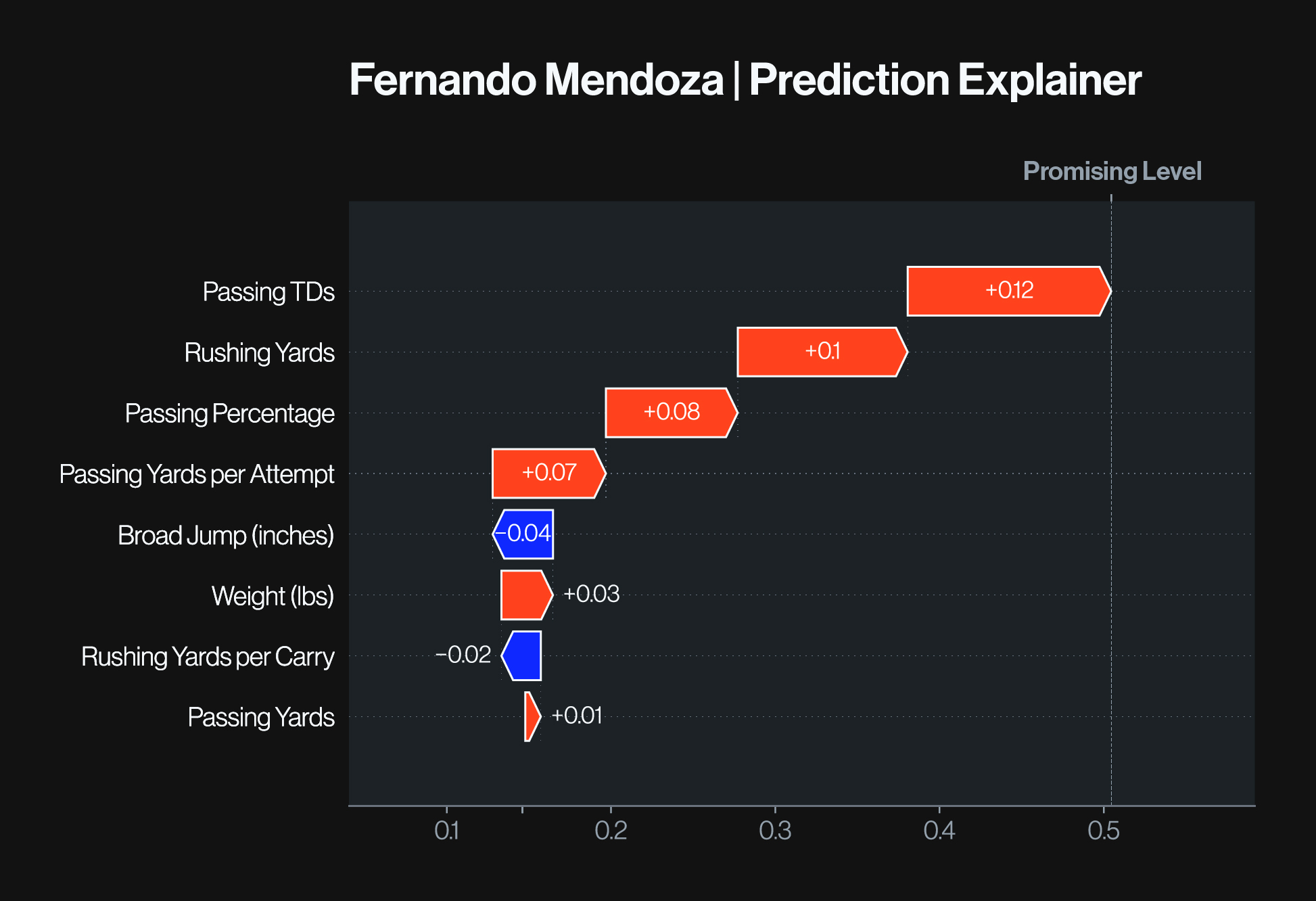
Quarterback remains the hardest position to project, but the model continues to favor players who pair passing production with efficiency and enough rushing value to expand their pathway to success. That pattern also comes through in the charts, where passing touchdowns, rushing output, and efficiency repeatedly stand out as key drivers.
Fernando Mendoza, Indiana | AI Success Prediction: 51%
Fernando Mendoza is one of the clearest examples of the model validating a top-tier quarterback profile.
His Heisman-winning, undefeated championship season at Indiana produced exactly the kind of statistical fingerprint the model rewards most strongly. His 24 passing touchdowns per season, using a recency-weighted average, are the biggest driver of his rating. Add in 156 rushing yards and a 67.9% completion rate, and Mendoza stands out as the strongest quarterback profile in the 2026 class.
He does not have a full Combine profile, which adds some uncertainty. But the indicators that matter most in the model still point clearly in his favor.
Jose “Joey” Aguilar, Tennessee | AI Success Prediction: 40%
Aguilar is one of the more interesting quarterback evaluations in the class because he sits higher in the model than he does in most draft conversations.
Widely viewed as a later-round option, he still grades out as the model’s second-best quarterback. That rating is driven by a strong production profile: 27 passing touchdowns per season, 189 rushing yards, and an elite 8.2 yards per attempt.
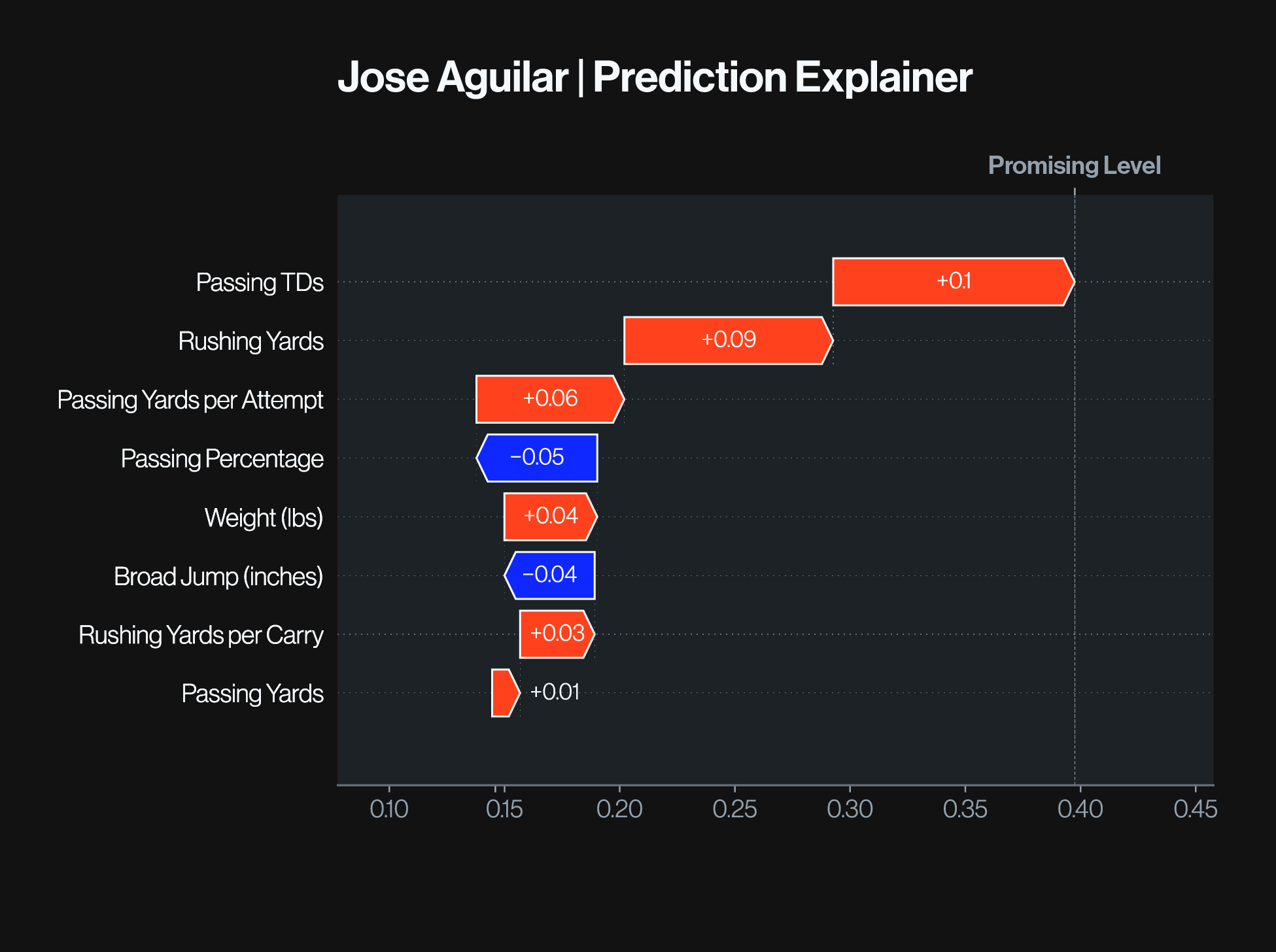
There is nuance here. Aguilar operated in Tennessee’s play-action-heavy offense, which may have boosted some of his efficiency numbers. His 62.3% completion rate is the clearest area working against him. Still, the broader profile, especially the combination of passing volume and rushing value, suggests a player worth more attention than current consensus may indicate.
Cole Payton, North Dakota State | AI Success Prediction: 39%
Cole Payton is the kind of prospect that helps explain why this type of modeling can be useful.
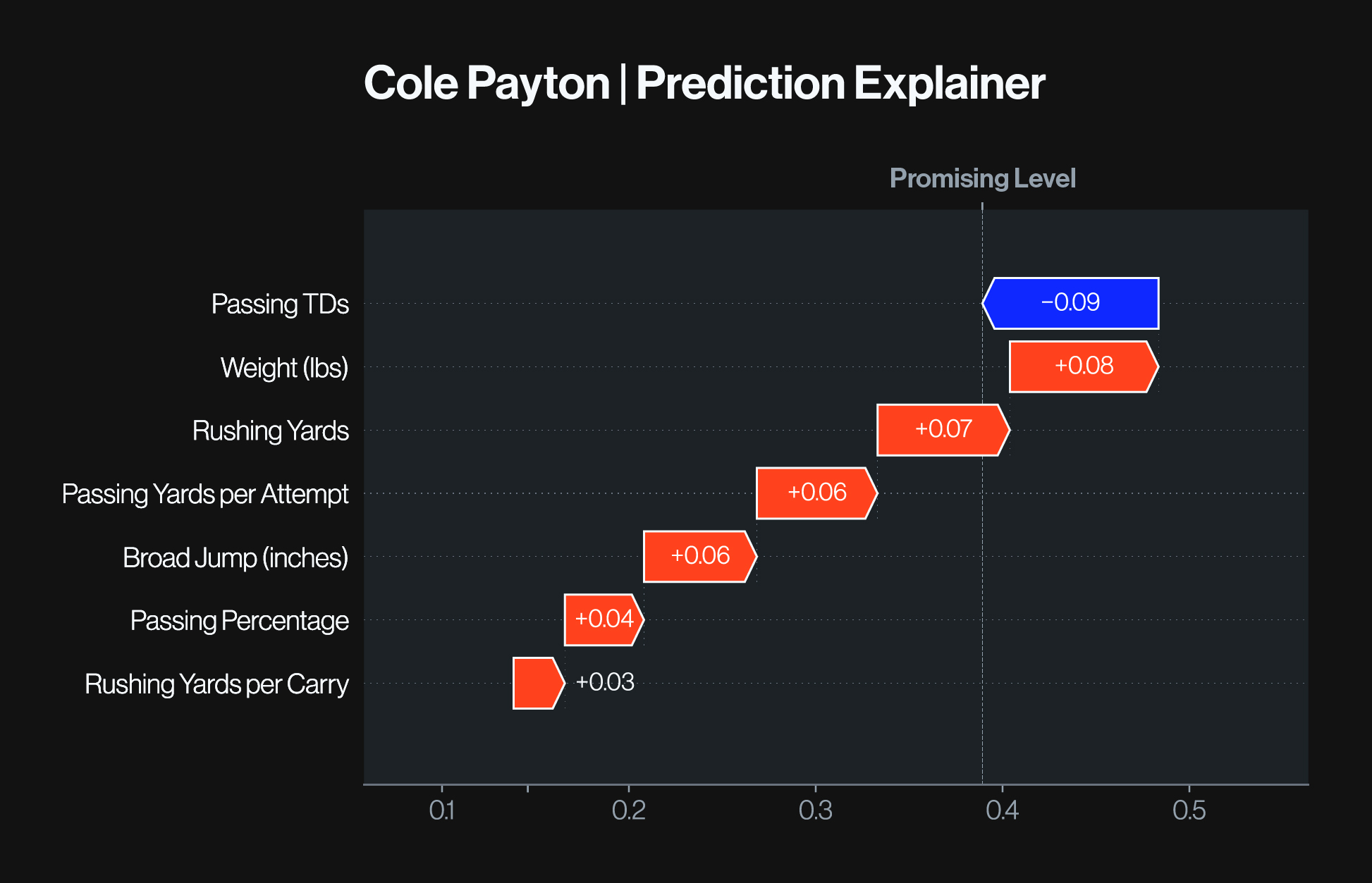
He is not a major name on most mock draft boards, but the model is less concerned with program prestige than with what the underlying profile suggests. In Payton’s case, his passing touchdown average of 5.25 per season works against him, though that figure is skewed by earlier seasons when he was not yet the starter. What pushes him up is his physical and athletic profile: a 232-pound frame, a 130-inch broad jump, 460 rushing yards, and 7.1 yards per carry.
It is an unusual combination of size, athleticism, and dual-threat value — and one the model is hard to dismiss.
The Brock Purdy comparison in the source material is also notable. In 2022, the model gave Purdy a 39% success rating, the highest in that class, before he was selected with the final pick of the draft. That does not mean Payton will follow the same path. But it does reinforce that when the model rates a small-school quarterback this highly, it is usually worth paying attention.
Wide Receivers: Where the Model Aligns — and Where It Looks Deeper
At wide receiver, the 2026 class includes both clear validation of widely recognized talent and a few names whose profile may be stronger than their projected draft position suggests.
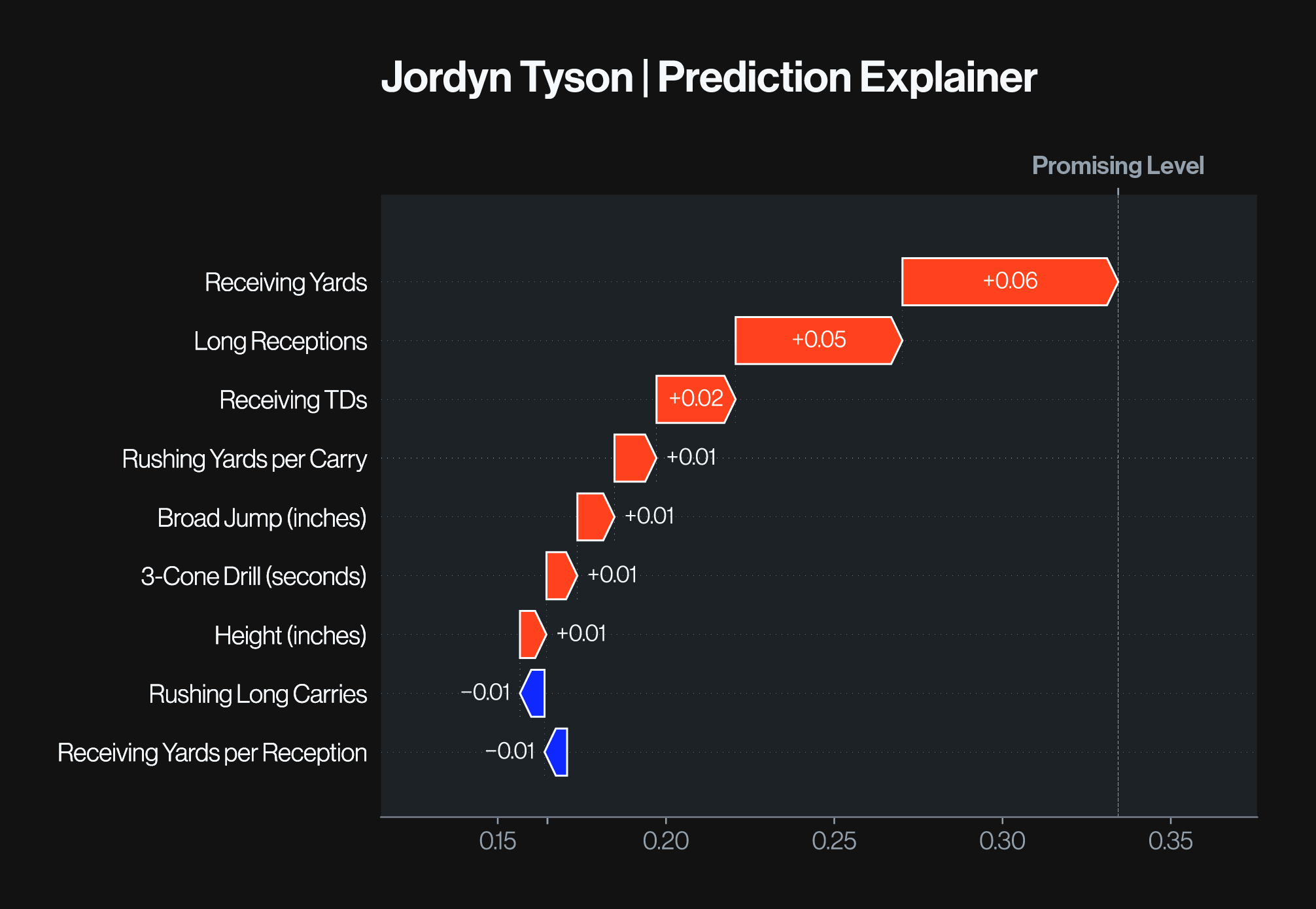
Jordyn Tyson, Arizona State | AI Success Prediction: 33%
Jordyn Tyson is one of the clearest alignment cases between the model and the broader scouting community.
He is widely viewed as one of the best receivers in the class, and the data supports that view. Tyson averaged 761 receiving yards per season, produced 66-yard long receptions, and scored 7.3 touchdowns per season. That mix of volume, big-play ability, and scoring is exactly the type of profile the model tends to reward at the position.
There is not much tension here. He looks like a strong prospect through both traditional and data-led lenses.
Ted Hurst, Georgia State | AI Success Prediction: 44%
Ted Hurst is one of the clearest value cases in the class.
He is one of the model’s highest-rated wide receivers in the 2026 group, despite being a player many casual fans may not know well and one currently projected closer to Day 3. The biggest driver is a rare size-speed combination: 6’4″ and a 4.42-second 40-yard dash. That alone puts him in a different athletic bucket than most receivers in the class.
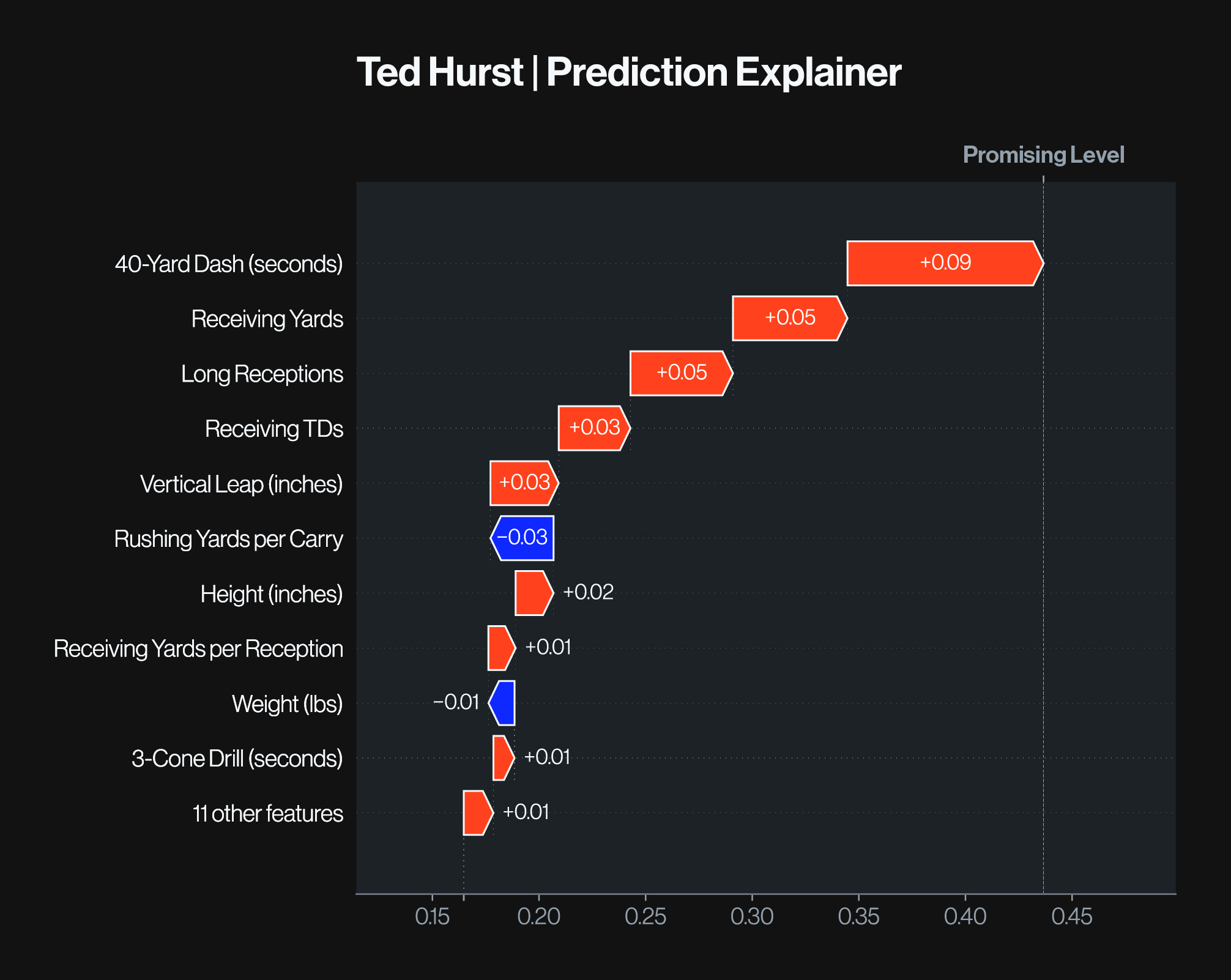
The production backs it up. Hurst averaged 983 receiving yards per season, produced 73-yard long receptions, and scored 7.5 touchdowns across his final two years at Georgia State. The source material also notes that he stood out at the Senior Bowl, offering another signal that his production can hold up against stronger competition. Taken together, this is the kind of profile that could outperform its draft slot in a meaningful way.
Elijah Sarratt, Indiana | AI Success Prediction: 31%
Elijah Sarratt gives the receiver group another strong production-led case.
As Fernando Mendoza’s top target during Indiana’s championship run, Sarratt hauled in 15 touchdowns during the undefeated season. His receiving yardage, averaging 912 per season, is the biggest factor behind his rating, while his 6’3″ frame and scoring production add further support.
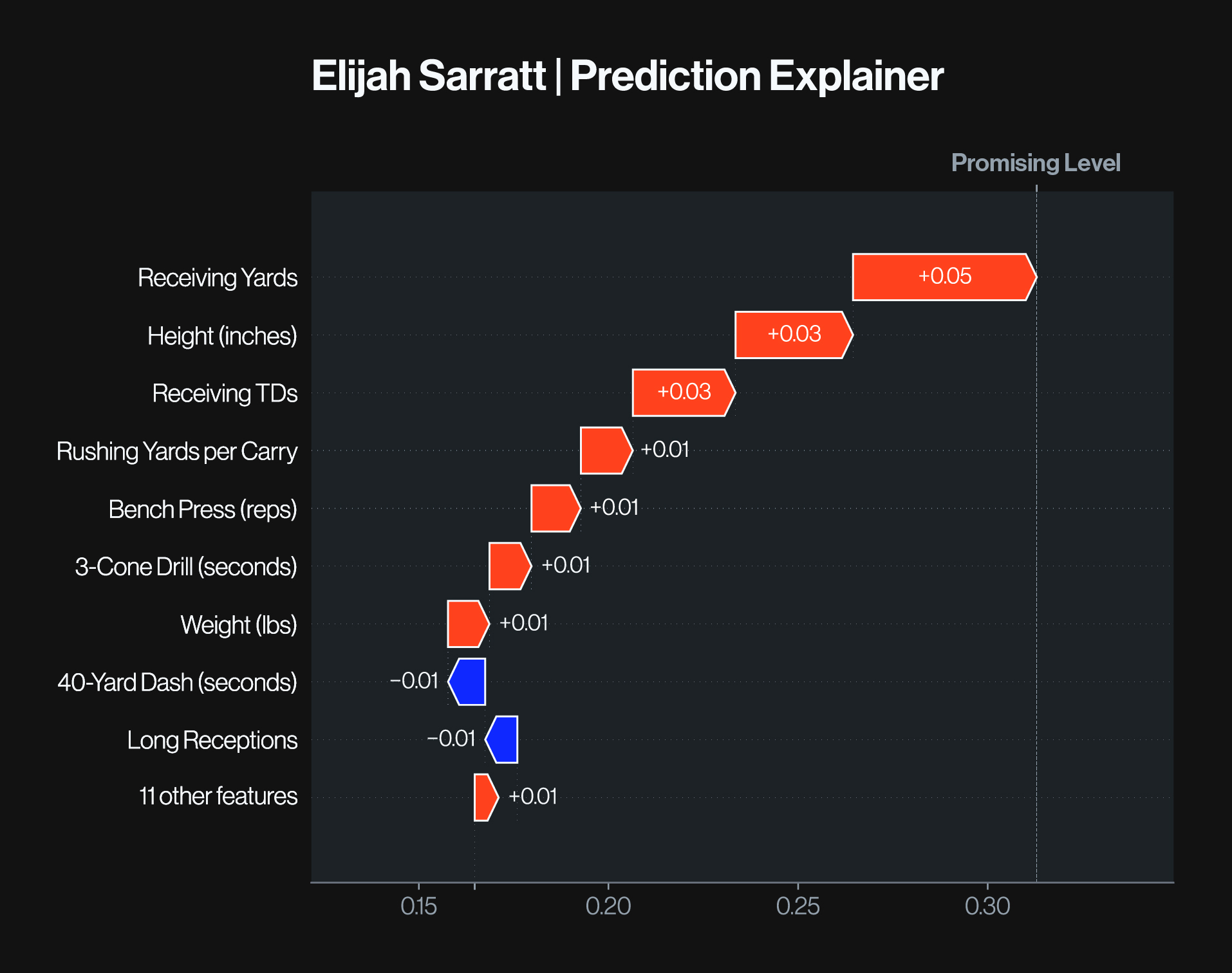
Some scouts have pointed to lower separation rates, and that is a fair concern. The model is less focused on how a receiver wins and more focused on what the production tells us about outcomes. Sarratt also did not complete a full set of Combine tests, which limits how fully the model can evaluate his athletic profile. Even so, the college production alone makes him a prospect worth watching closely.
Running Backs: Clear Strength at the Top, Intriguing Value Behind It
The running back class includes one of the strongest overall profiles in the draft, followed by a pair of less conventional names the model still likes for very specific reasons. The charts make that contrast clear, showing both the strength of Love’s all-around profile and the distinct traits driving interest in Reid and Heidenreich.
Jeremiyah Love, Notre Dame | AI Success Prediction: 59%
Jeremiyah Love is the cleanest running back profile in the class.
The source material describes him as a prospect with no real statistical weaknesses, and the numbers support that. He checks the boxes on rushing production, receiving involvement, and athletic testing: 12 rushing touchdowns, 6.4 yards per carry, 961 rushing yards per season, a 4.36-second 40-yard dash, and meaningful contributions as a receiver.
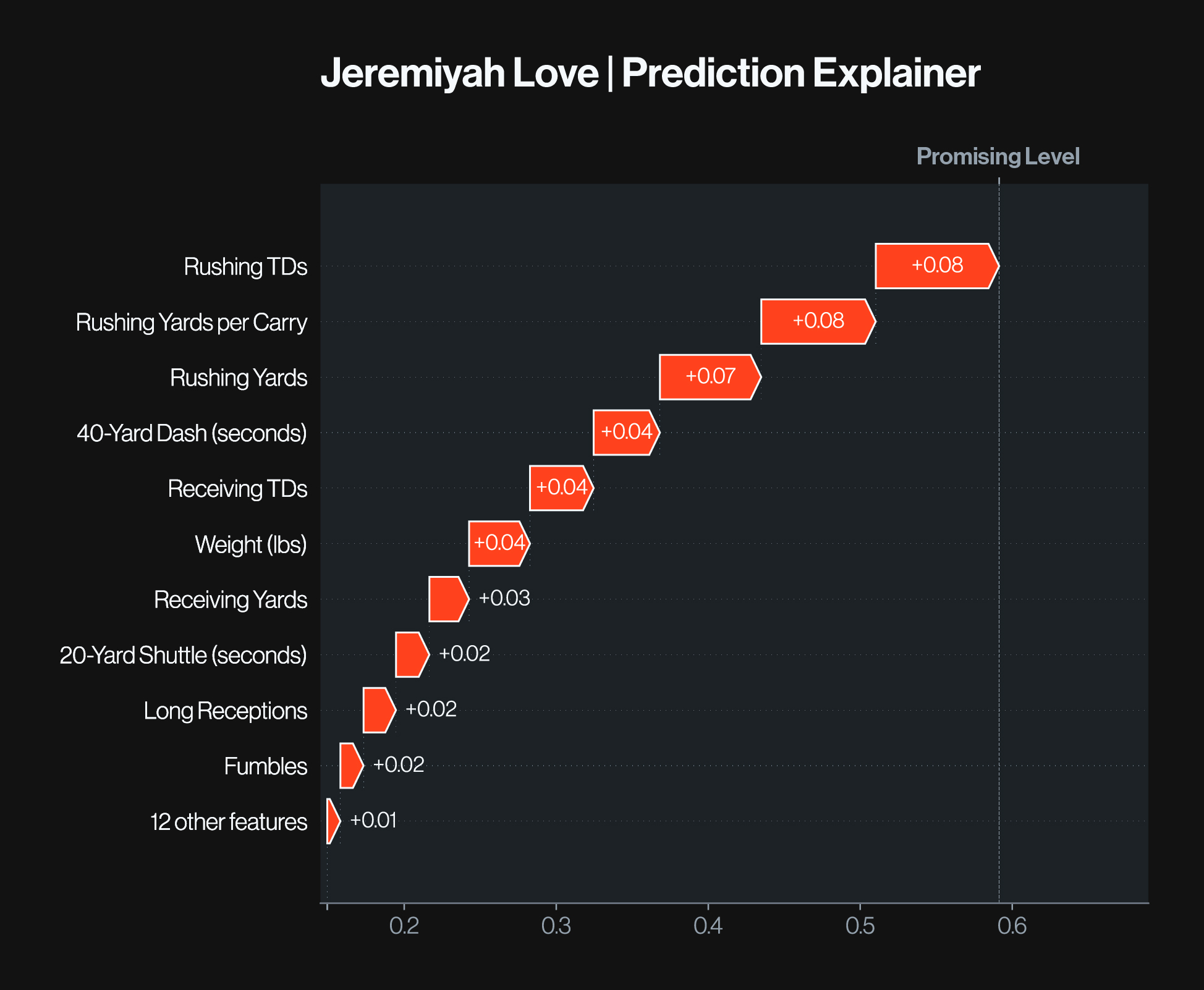
That is why he sits comfortably as the consensus RB1 and why the model sees him as one of the strongest prospects in the entire draft.
The Bijan Robinson comparison offers useful context. The model gave Robinson a 62% rating in 2023 before he developed into one of the NFL’s top backs. Love’s 59% places him in similarly strong company.
Desmond Reid, Pittsburgh | AI Success Prediction: 27%
Desmond Reid is a good example of the model surfacing a player whose profile fits where the league is going, even if the draft market has understandable concerns.
At 5’8″ and 174 pounds, his size is a legitimate question, and the model does flag weight as a negative factor. But other parts of his profile are compelling: 6.0 yards per carry, 325 receiving yards, 1.75 receiving touchdowns per season, and 51-yard long receptions.
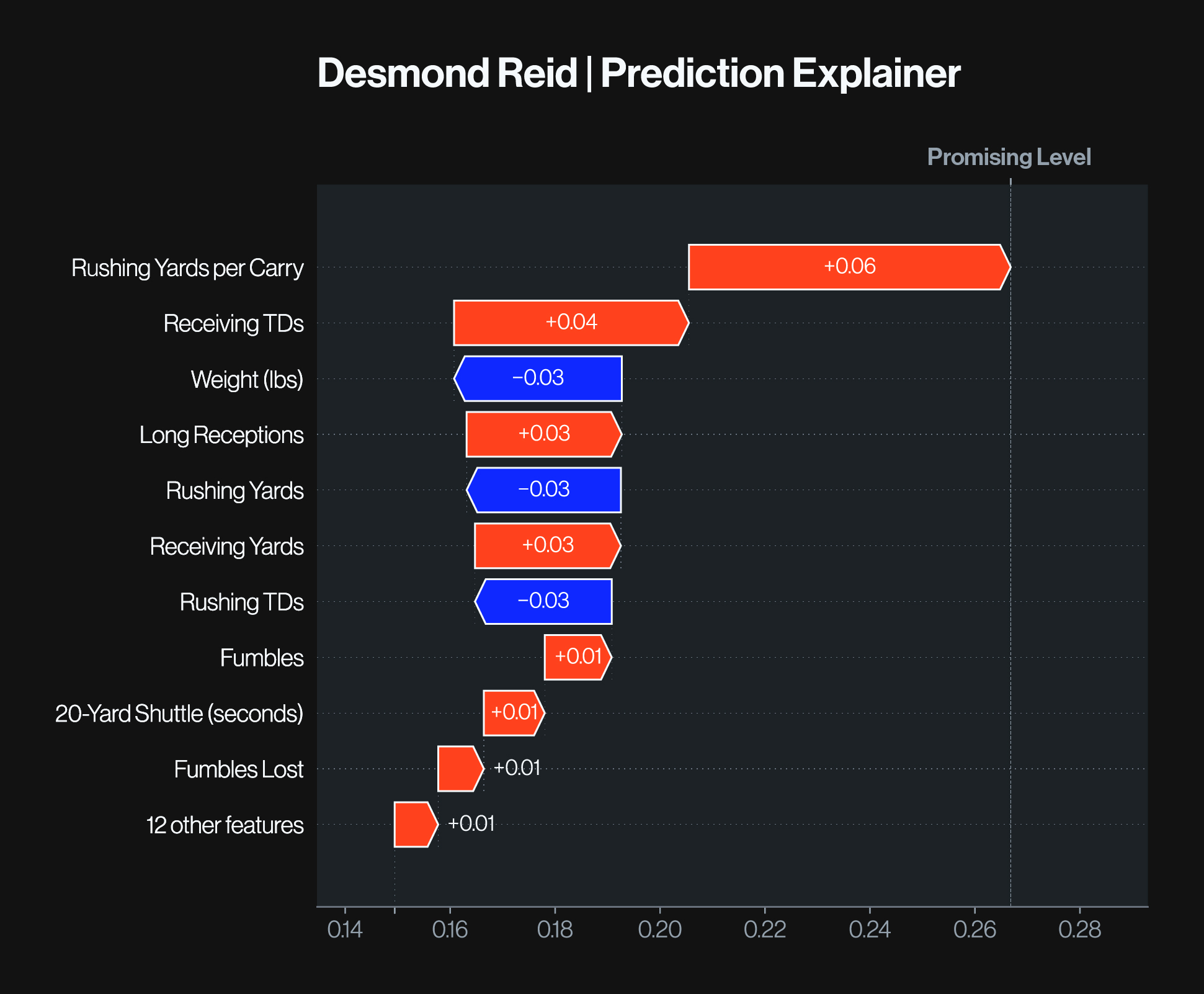
That matters because yards per carry is the model’s strongest predictor of running back success, and Reid excels there. In a league that increasingly values versatile, pass-catching backs, his profile may be more relevant than his projected draft position suggests.
Eli Heidenreich, Navy | AI Success Prediction: 24%
Eli Heidenreich is one of the more unconventional names in the group, but also one of the most interesting.
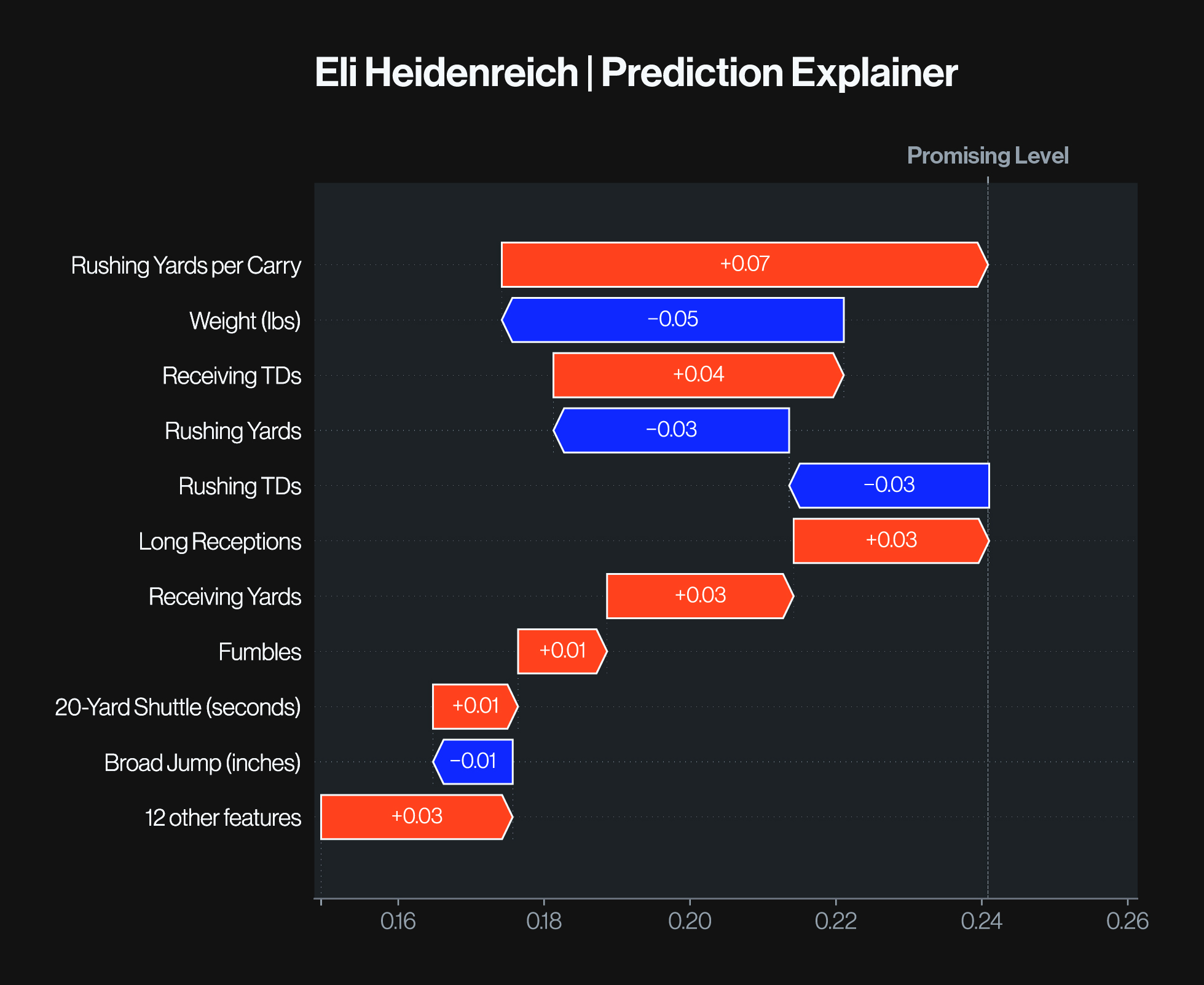
A hybrid running back and receiver from Navy, he profiles more as a receiving weapon than a traditional high-volume ball-carrier. His rating is driven upward by elite rushing efficiency at 7.1 yards per carry and strong receiving production, including 5.3 receiving touchdowns and 665 receiving yards.
At the same time, lower weight at 198 pounds and limited rushing volume work against him. That makes him a true push-and-pull evaluation. Still, as offensive roles continue to evolve, this kind of versatility can create value well beyond where a player is drafted.
What Stands Out Most in the 2026 Class
At the top of the class, the model’s strongest ratings belong to players like Mendoza, Love, and Tyson — prospects whose production and overall profile already align with broader expectations.
The more interesting story is what happens beyond that.
Aguilar’s production profile suggests more upside than current draft narratives may reflect. Payton’s blend of size and dual-threat athleticism makes him a name worth watching. Hurst looks like one of the clearest wide receiver value plays in the class. Reid’s pass-catching versatility fits the direction of the modern NFL, even if his frame creates understandable hesitation.
That is where this kind of analysis can be most useful.
Not in replacing scouting. Not in reducing the draft to a single number. But in adding another layer of evidence to a process shaped by uncertainty.
As teams look ahead to the 2026 NFL Draft, the opportunity is not just to evaluate more prospects. It is to evaluate them more clearly. And that is where combining scouting expertise with data-driven analysis can lead to clearer, more informed decisions.