Injury reporting only holds up when the records behind it are complete.
Injury records are more than case documentation. They shape how medical teams review injury trends, burden, and time-loss over time. But records are often logged under clinical pressure, with fields left blank, coded inconsistently, or left open after a case resolves. Those gaps surface later in the dashboards and reports the medical team is asked to stand behind:
- A preliminary injury may be logged but never fully classified
- A missing body area, classification, or code can weaken injury review outputs
- An unknown activity or contact type can limit mechanism-of-injury analysis
- An injury linked to the wrong event can distort its game or session context
- An unresolved case can quietly inflate time-loss, burden, and incidence figures
The Medical Data Health Checks Dashboard in My iP gives medical teams a repeatable way to surface those gaps before they affect reporting.
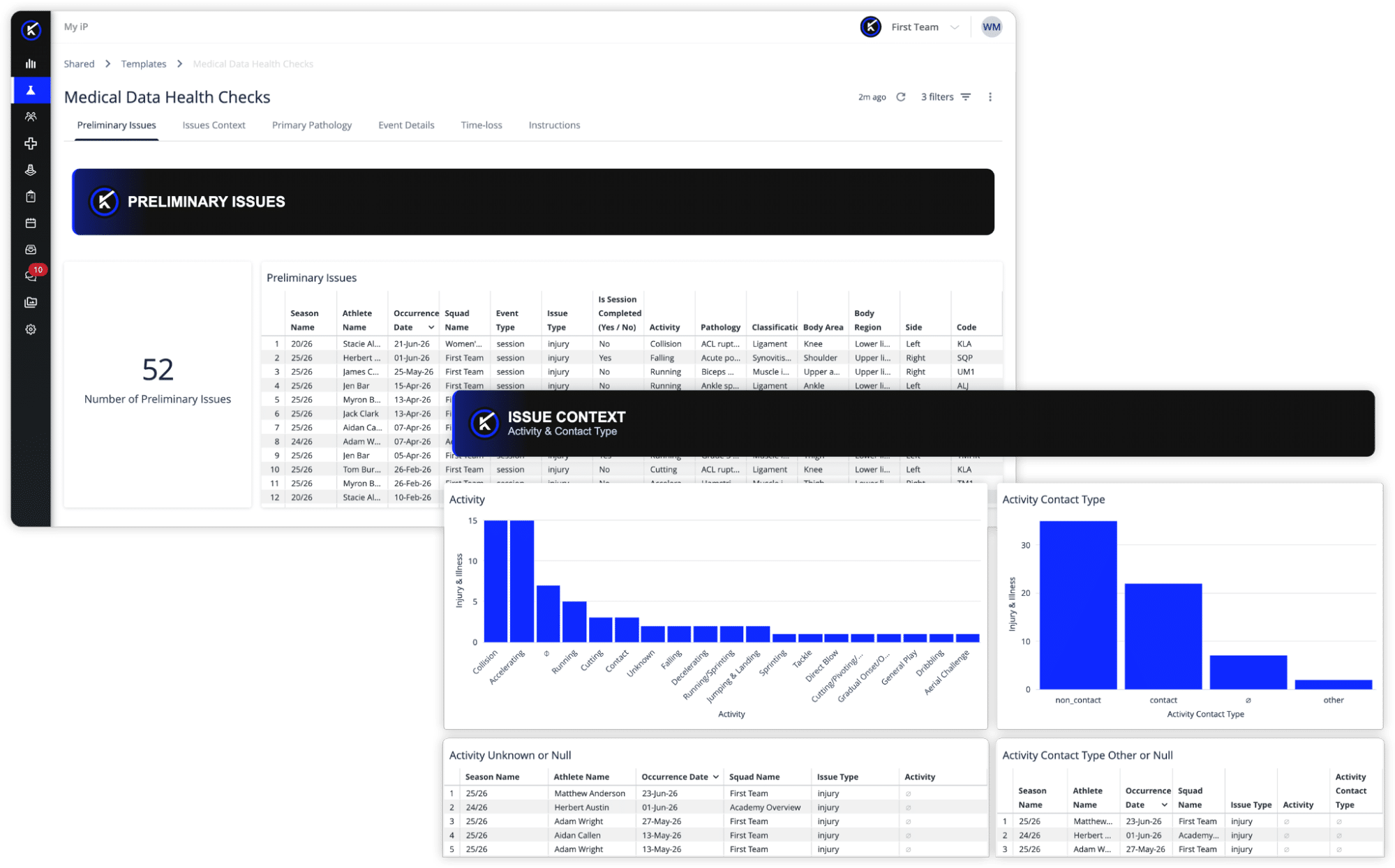
Available as part of the Data Health experience in My iP for teams using the Performance Medicine Solution in iP: Intelligence Platform, it helps medical staff review the integrity of injury records before they affect injury review, medical reporting, and downstream analysis.
Why Medical Data Health Matters
Injury records are the foundation behind the medical dashboards, surveillance figures, and review conversations medical teams depend on.
They sit behind questions like:
- Are injury records complete enough to report on?
- Are injuries classified consistently across the team?
- Are activity, contact type, pathology, body area, side, and onset type captured?
- Are cases linked to the correct game, session, or event?
- Are open and severe time-loss cases accurate, or just unclosed?
- Can injury review outputs be trusted before they are shared?
Records are often logged under clinical pressure, with fields left blank in the moment and never completed later. The gap may not show until an injury review tile renders empty, a burden calculation looks off, or a governing body submission asks for fields that were never filled in.
That creates rework at the worst time, when the medical team is already trying to finalize reporting or explain the injury picture to a board or governing body.
Instead of finding these gaps downstream, medical teams need a way to check injury records earlier, on their own cadence.
A Clearer Way to Check Injury Data Quality
The Medical Data Health Checks Dashboard brings the injury record checks medical teams care about into one view, so staff can see where records need attention before reporting depends on them.
It is designed to move medical teams from ad-hoc, case-by-case triage to a repeatable data-quality routine owned by the people who know the records best.

The dashboard helps medical teams review:
- Preliminary injuries that are logged but not yet classified
- Activity and contact type
- Clinical fields: pathology, classification, body area, side, code, and onset type
- Game, session, and event linkage
- Participation records
- Open cases and severe time-loss cases
The goal is not just to find missing fields. It is to give medical teams a clear starting point for completing and resolving records before they affect injury review, board reporting, governing body submissions, or analysis.
What the Dashboard Helps Teams Review
The dashboard gives medical teams a default view of common injury data-quality checks. Designated users can personalize the template over time to reflect the organization’s clinical workflow, coding standards, reporting needs, and review priorities.
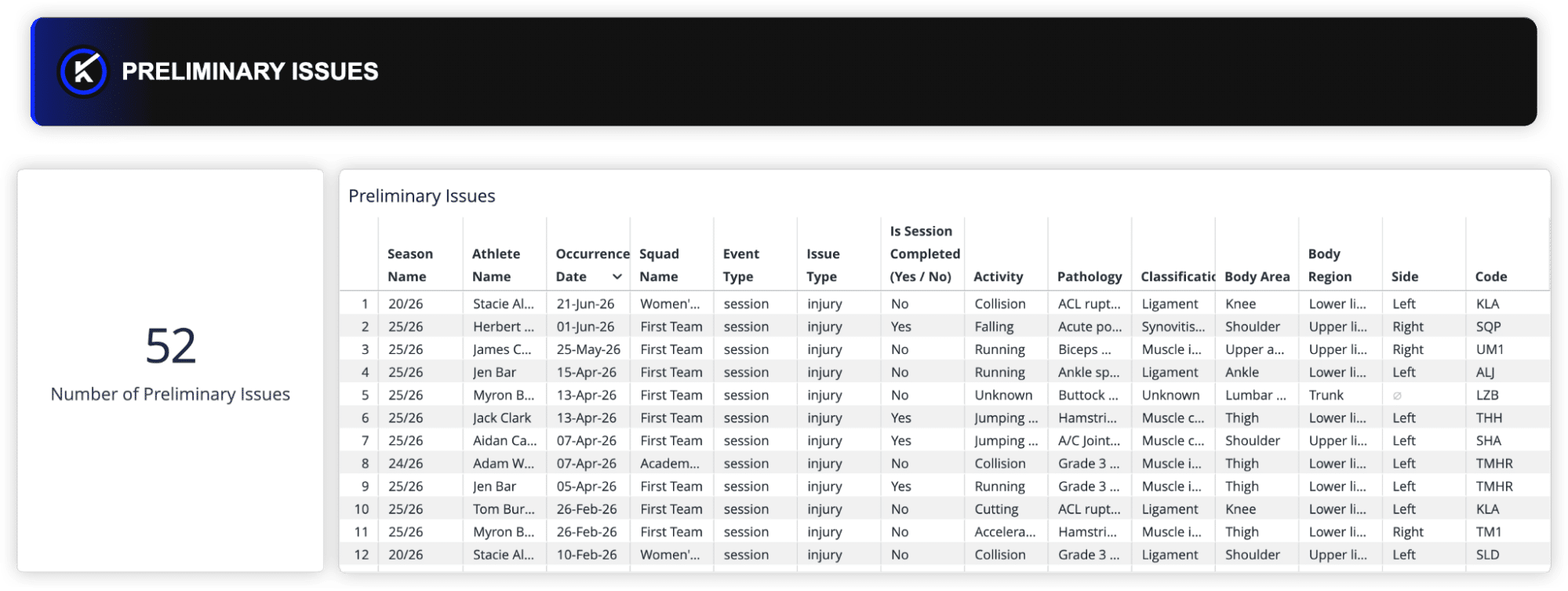
PRELIMINARY ISSUES
A headline view of injuries that have been logged but not yet fully resolved.
This gives medical staff a fast read on which records still need key clinical fields completed before they feed injury review or reporting.
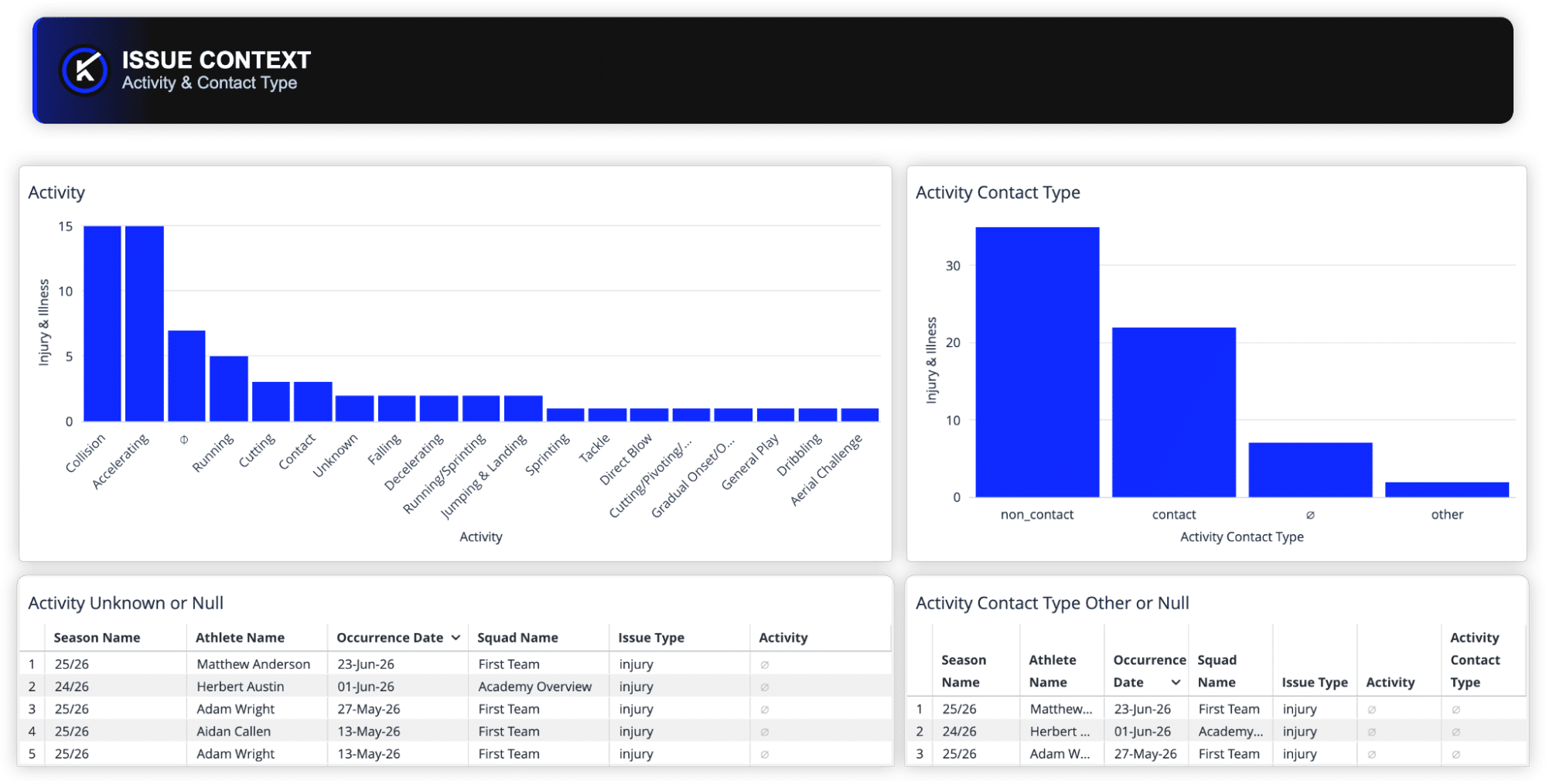
ISSUE CONTEXT
Activity and contact type underpin how the team understands mechanism of injury.
The dashboard helps medical staff review activity values, contact type distribution, and injuries where activity or contact type is unknown, generic, or missing, supporting cleaner mechanism-of-injury analysis and more meaningful review.
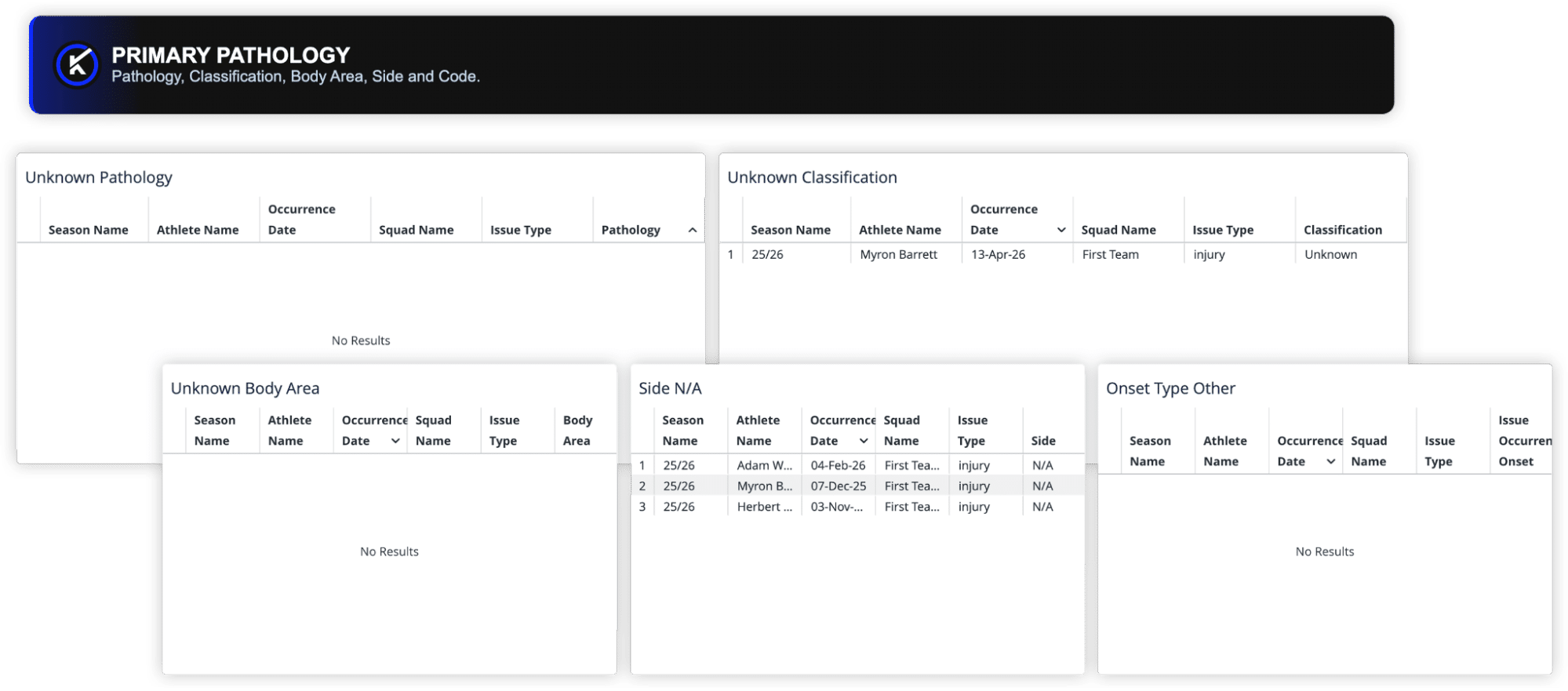
PRIMARY PATHOLOGY
Clinical fields such as pathology, classification, body area, side, code, and onset type are central to injury surveillance and reporting.
The dashboard surfaces records where these fields are missing, unknown, or set to generic values, giving medical staff a focused list of injuries that need follow-up before figures are shared.
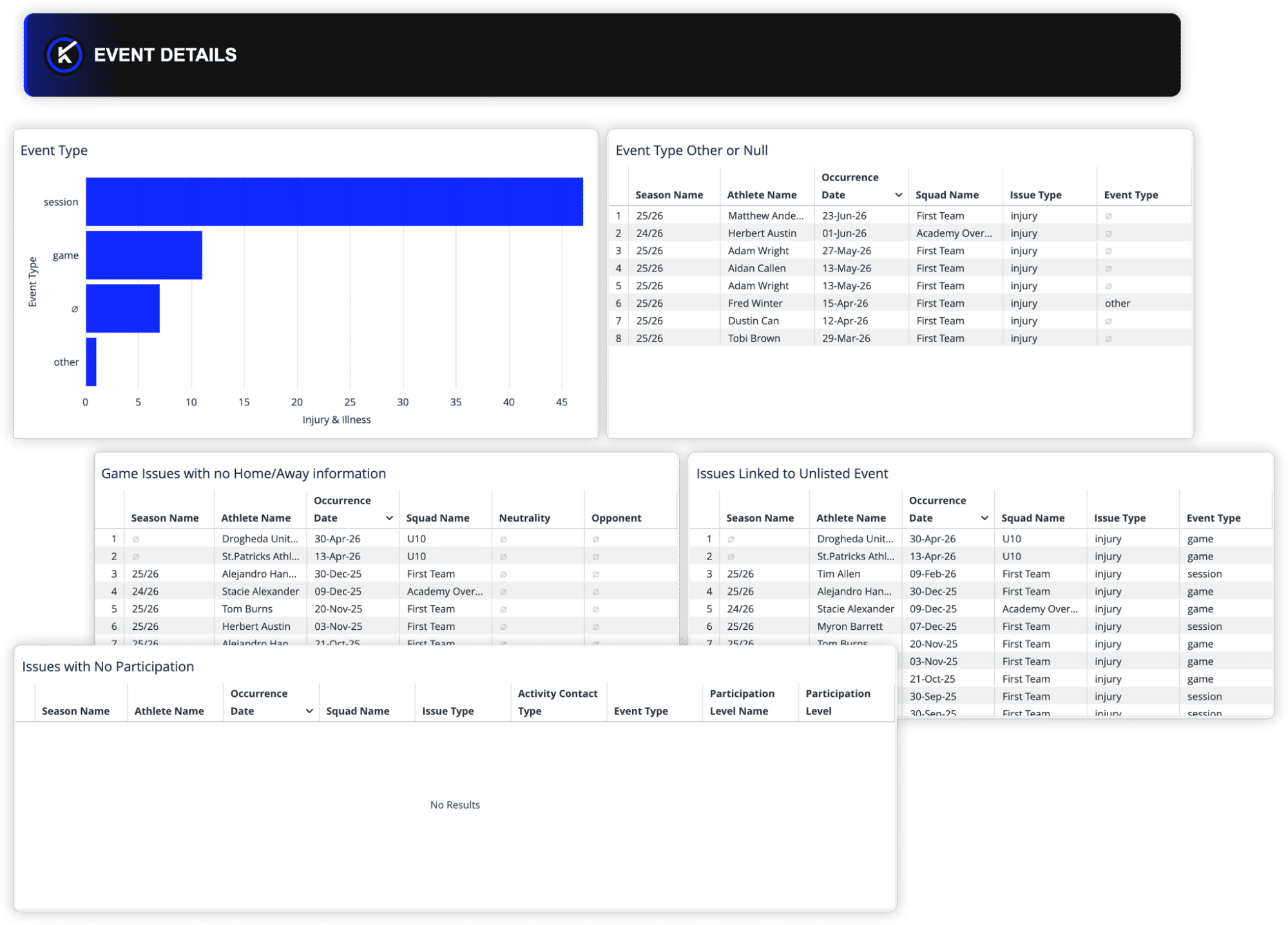
EVENT DETAILS
Injuries usually need to be connected to the correct game, session, or event.
The dashboard helps medical staff review event type, missing venue details, injuries linked to unlisted events, injuries recorded on days with no matching game or session, and injuries with no participation record, so the context behind each case holds up.
TIME-LOSS
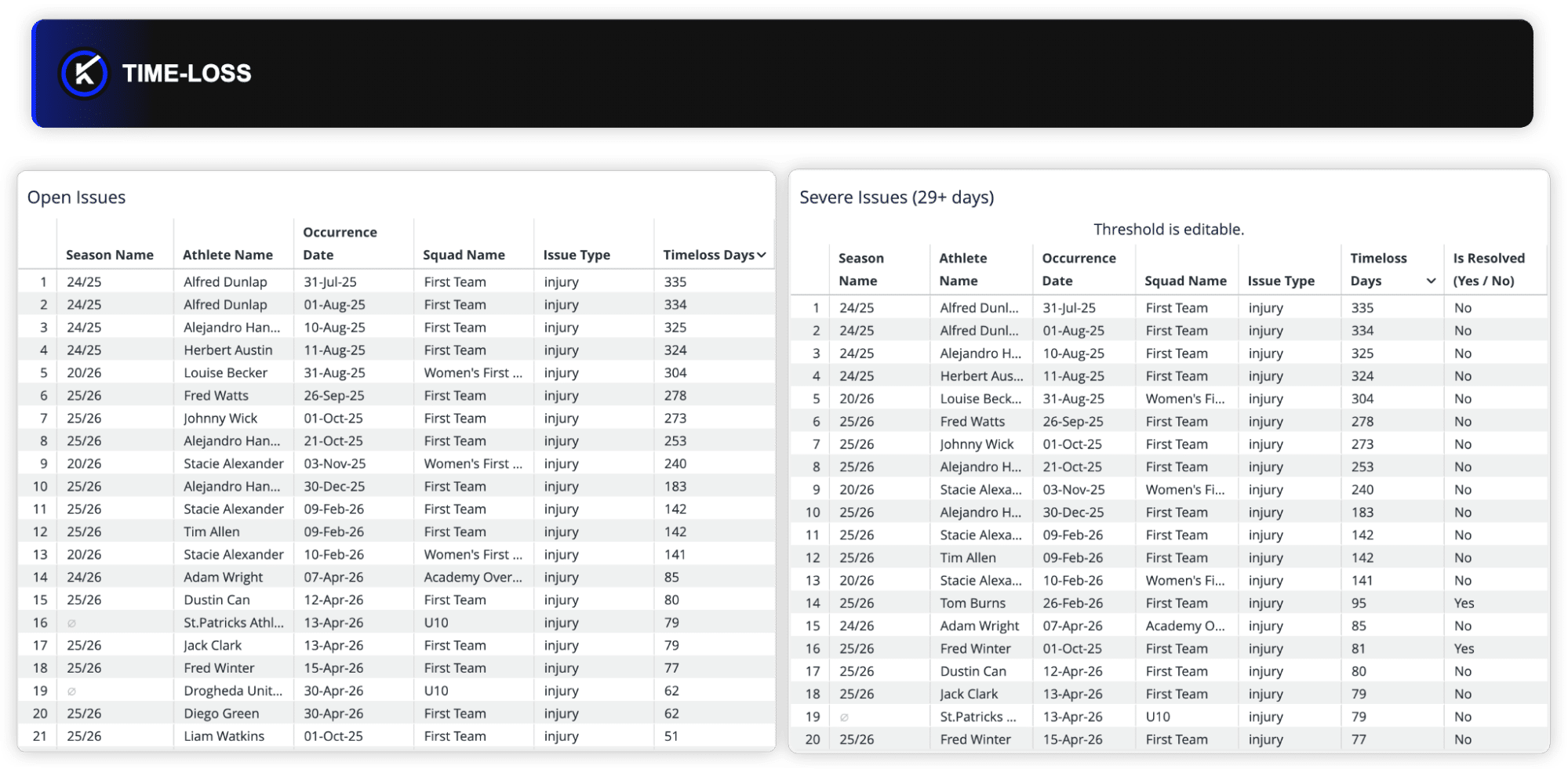
Time-loss and case status drive burden, severity, and incidence figures.
The dashboard helps medical staff identify open cases, days lost, and severe time-loss cases that need review, whether because they are genuinely long-term or because a case was never closed correctly.
When Teams Should Use Medical Data Health Checks
This dashboard works best when medical teams run it on a regular cadence, with a clear owner for the clean-up that follows.
That cadence might include:
- A weekly or routine medical data-quality review
- Before injury review dashboards are shared
- Before end-of-block or end-of-season injury reporting
- Before board-level or governing body submissions
- During onboarding or dashboard rollout
- When injury analytics look incomplete, inconsistent, or unexpected
- When open cases, severe time-loss, or event-linked injuries need a closer look
Run consistently, the dashboard helps medical teams catch record issues earlier, reduce manual triage, and protect confidence in the injury reporting they are accountable for.
Who Benefits from Medical Data Health Checks?
Heads of Medical
For Heads of Medical, injury data quality is about being able to stand behind the numbers. Surveillance figures, board reports, and governing body submissions all have to hold up to scrutiny.
The dashboard helps ensure those figures are built on complete, consistently classified records, so the medical picture presented to stakeholders reflects the data, not gaps in it.
Medical Admins and Data Managers
For the staff responsible for injury record quality, the dashboard replaces manual, case-by-case checking with one view of the issues that need attention.
Instead of trawling individual records, they can see common data-quality gaps in one place and prioritize what to complete or resolve first.
Physios and Athletic Trainers
For physios and athletic trainers, the dashboard helps surface which of their own cases still need follow-through.
It gives clinical staff a clear way to find cases with missing fields, open status, unresolved time-loss, or event-linking issues, without searching record by record.
Analysts and Reporting Owners
For analysts and reporting owners, injury data quality shapes how confidently they can segment and interpret injury trends.
Knowing which records need review reduces rework, especially when building reports by classification, body area, mechanism, severity, time-loss, or season.
Supporting Better Data Review, Not Automatic Decisions
The Medical Data Health Checks Dashboard helps surface records that may need attention, but it does not decide what should happen next, and it makes no clinical judgment about the injury itself.
A severe time-loss case may be a genuine long-term injury, or a case that was never closed correctly. An “other” contact type may be legitimate, or it may need remapping. An event-linking issue may need correcting, or it may point to a workflow worth reviewing.
The dashboard gives medical teams a shared starting point for review. What to complete, resolve, or leave as-is stays with the clinical staff who know the cases.
Cleaner Injury Data, Stronger Medical Reporting
Medical Data Health Checks Dashboard in My iP helps medical teams strengthen the data behind key Performance Medicine workflows, including injury review, medical analysis, and the reports they share with stakeholders.
By surfacing incomplete, inconsistently coded, or unresolved records in one repeatable view, medical teams can spend less time hunting for problems and more time improving the quality of the data their reporting depends on.
Cleaner injury data makes medical reporting easier to trust.
And when the reporting is easier to trust, medical teams can move faster from data review to a clearer injury picture.
Contact us to explore how Data Health experience in My iP can help your organization strengthen the data behind its reporting.