The athletic trainer’s job has outgrown the EMR.
What was once a documentation-first role now spans return to play, availability monitoring, concussion protocols, surveillance reporting, team physician communication, and daily coordination with strength staff, coaches, and leadership. Usually with the same hours and the same headcount.
The encounter is still part of the job. It’s no longer the whole job.
Most athletic training EMR systems are still scoped to the old version of the role: log the injury, document the treatment, export the report. That gap, between what the system was built to do and what the role now requires, is where the workload builds.
If your Sunday nights go to pulling reports in Excel, rebuilding the same return to play workflow for every sport, or chasing physician approvals by email, the process isn’t broken. The job has evolved faster than the systems supporting it.
The Athletic Trainer Shouldn’t Be the Integration Layer
In most programs, the athletic trainer is the one person who sees the whole athlete picture. They know who’s injured, who’s restricted, who’s progressing, who’s available, and who needs to be discussed with the physician, coach, or strength staff.
When the system can’t connect those inputs, the athletic trainer becomes the integration layer. They pull workload data from one platform, check wellness responses in another, update availability by hand, rebuild reports in a spreadsheet, and message staff separately to keep everyone aligned.
That isn’t efficient, and it doesn’t scale. It leaves too much of the athlete health picture dependent on one person’s manual work.
The Performance Medicine Solution in iP: Intelligence Platform connects medical workflows to the athlete data, operational context, and stakeholder visibility athletic trainers rely on every day. Documentation, rehabilitation, availability, surveillance, and decision support sit in one system, so practitioners spend less time assembling information and more time acting on it.
What Changes When the Medical System Is Connected
Here’s what that looks like on an ordinary Tuesday.
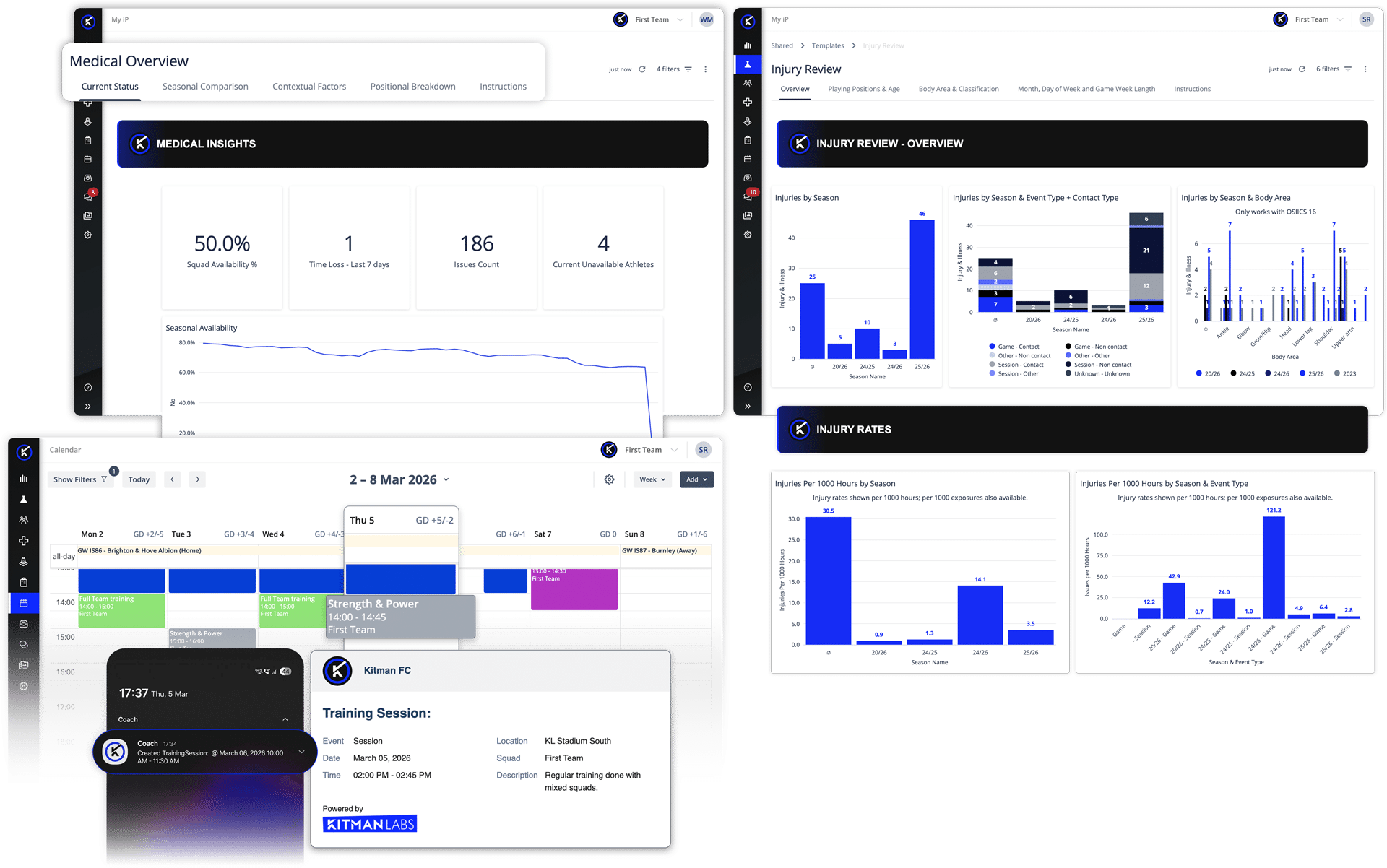
An athlete pulls up in a session. The athletic trainer logs the injury at the point of care, with body area, pathology, mechanism, and the session it happened in already attached. That record updates the athlete’s status and availability, so the strength coach sees the restriction before the next morning’s session instead of hearing about it in a hallway. The team physician reviews and approves the next stage of the return to play progression inside the record, not over email. The same tagged detail feeds surveillance reporting, so the end-of-season injury audit is a filter rather than a rebuild.
No re-entry. No parallel spreadsheet. No chasing.
Documentation supports the next step instead of ending at the record. Injury detail informs rehabilitation, status changes update availability, and tagged context like game, session, and mechanism makes surveillance meaningful at the point of care rather than reconstructed months later. Structured intake, health history, and consent workflows run in the same system through forms and data collection in iP, so medical paperwork stops living in separate surveys and PDFs.
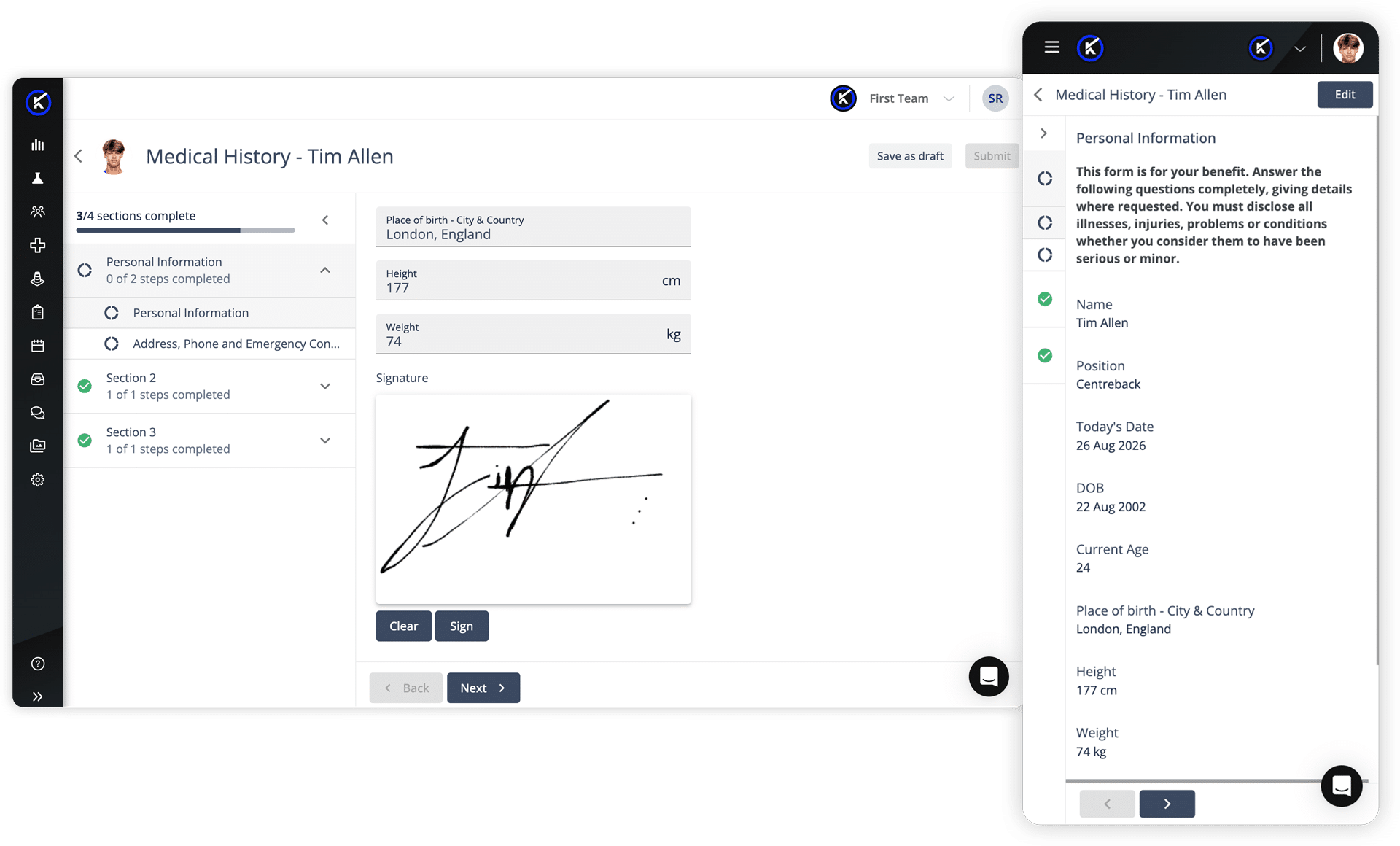
Reporting stops being a weekend project. The Medical Overview Dashboard and Injury Review Dashboard in My iP are standard with Performance Medicine and ready from day one. Medical Overview gives staff a live readout of who’s unavailable, recent time loss, and how team availability is trending. Injury Review handles surveillance: injury counts by event and contact type, exposure-adjusted rates alongside raw counts, and which injury types carry the most time loss. Neither one is a configuration project, and self-service reporting lets teams adapt them from there.
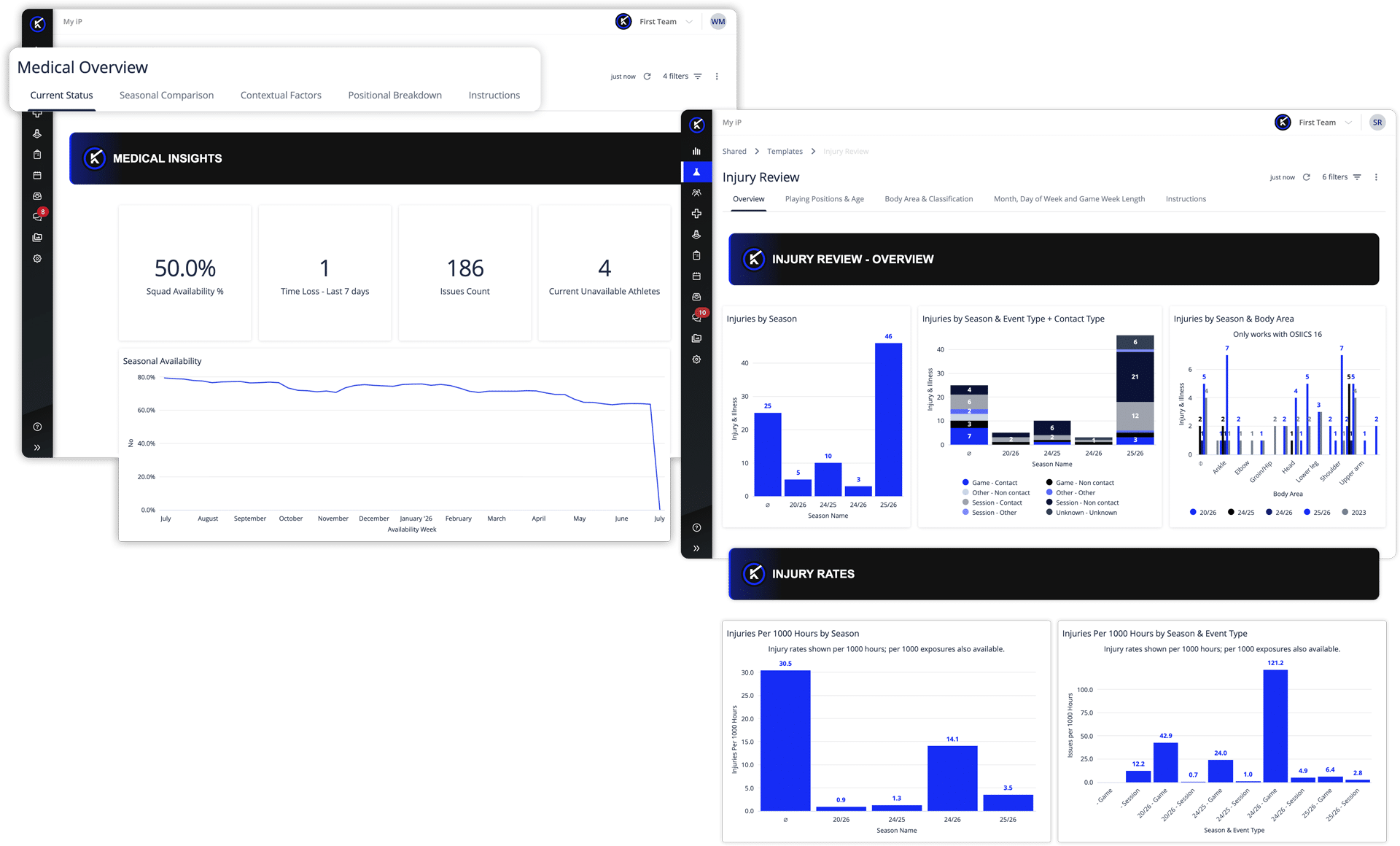
Record quality is checked, not assumed. Surveillance is only as good as the records behind it, and incomplete classifications or unlinked events quietly distort the numbers. The Data Health experience works at two points. Quality is strengthened at intake, so gaps surface while the athletic trainer is still in the record rather than months later in a board report. Medical Data Health Checks in My iP then give medical staff a repeatable review routine for unclassified injuries, incomplete pathology fields, and injuries not linked to the right game or session. Both arrive with Performance Medicine.
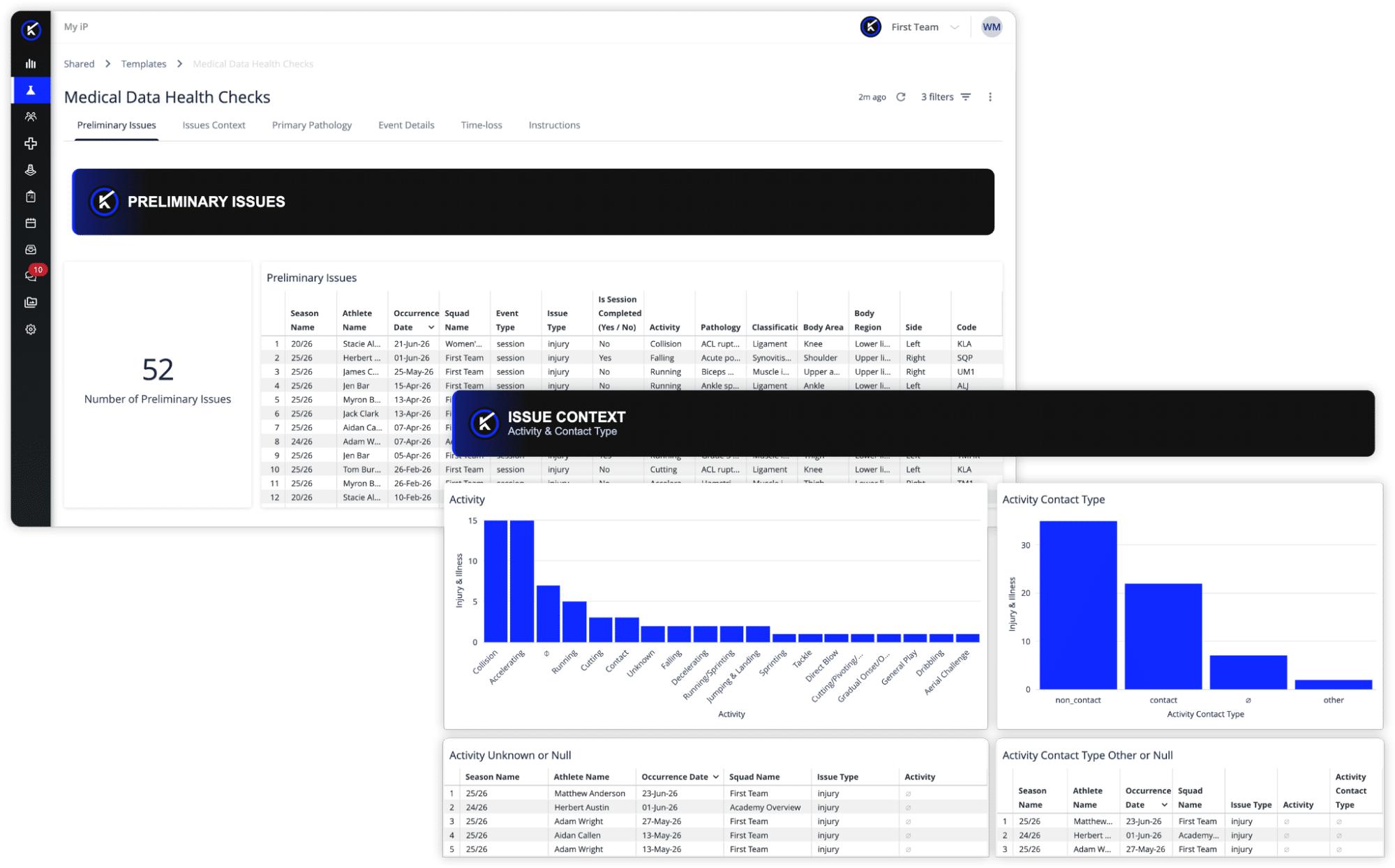
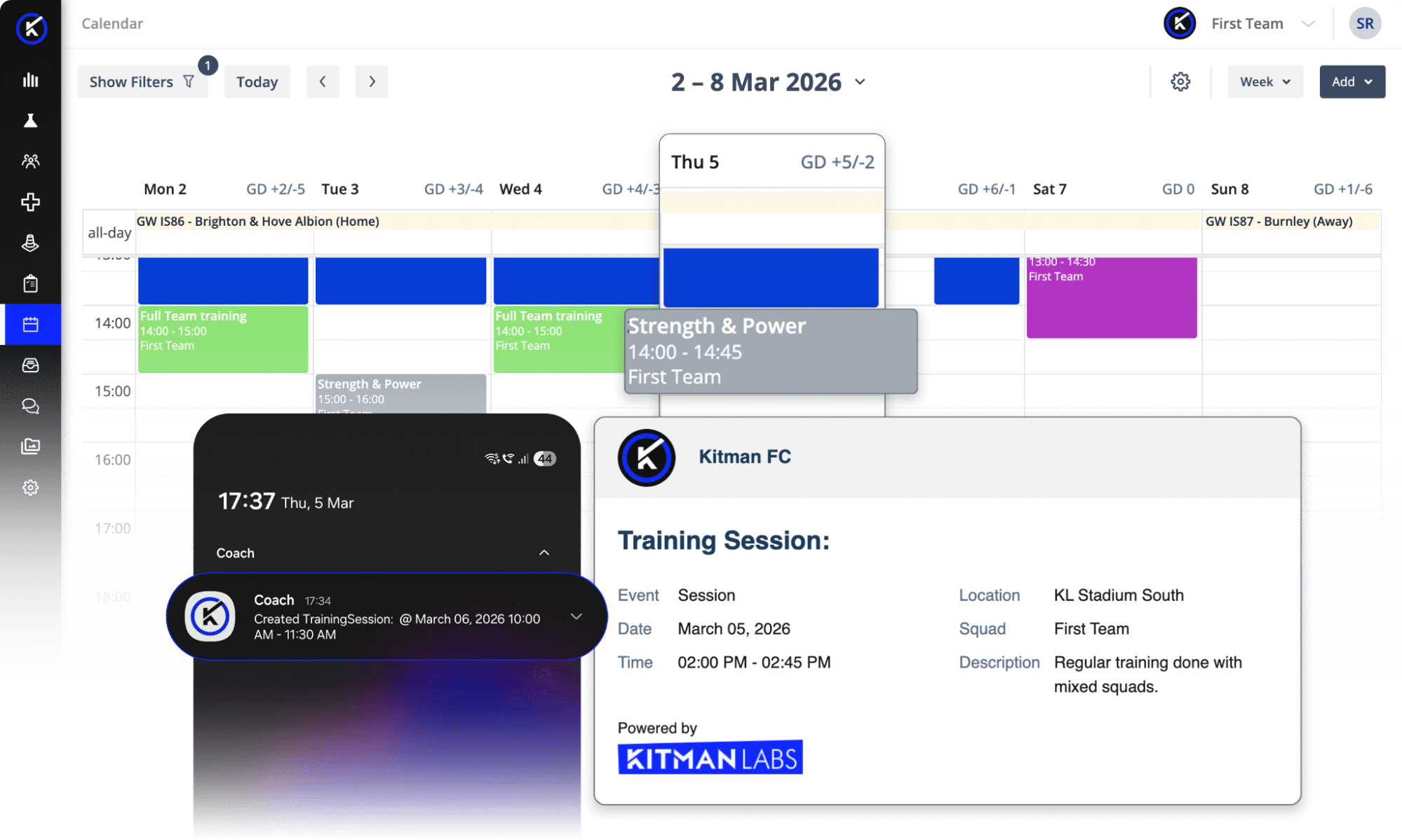
Care coordination moves into the system. Because Performance Medicine sits within iP, teams also gain the operational foundation of iP Core, including athlete profiles, calendars, communication, and availability, plus stakeholder-ready visibility through My iP. Native healthcare network integrations across lab, imaging, pharmacy, and e-fax mean outside results and physician correspondence land in the athlete record instead of a separate inbox.
Athletic Training EMR Systems vs. Performance Medicine in iP: Intelligence Platform
The difference isn’t the number of features. It’s what the system helps the athletic trainer do with the information.
| Athletic Training EMR Systems | Performance Medicine in iP: Intelligence Platform | |
Daily Documentation | Document injuries, treatments, and return to play status | Connect documentation to rehabilitation, availability, surveillance, and return to play |
Medical Records | Store medical records | Link medical data with wellness, testing, exposure, and availability |
Return to Play | Track return to play status | Manage return to play progression with status, milestones, restrictions, and athlete data |
Reporting & Dashboards | Standard report exports, or build your own | Medical Overview, Injury Review, and Medical Data Health Check Dashboards standard from day one, plus self-service reporting to adapt them |
Provider Network | Correspond with outside providers by email and fax | Native healthcare network integrations across lab, imaging, pharmacy, and e-fax |
Access & Visibility | Share through limited permissions | Role-based visibility across medical, performance, coaching, and leadership |
Scale Across Teams | Built around team-level documentation | Standardize workflows and surveillance across teams, sports, and departments |
For a full capability-by-capability comparison, see Sports EMR Software vs. Performance Medicine.
An EMR helps athletic trainers document what happened. Performance Medicine helps them manage what happens next, across every team and sport they cover. That’s what more than an EMR actually means in daily practice.
Built as One Platform, Not Assembled From Acquisitions
Connected is a word every vendor in this category uses. The question worth asking is how the connection was built.
Many systems became suites through acquisition: an EMR bought here, a monitoring tool bought there, a reporting layer added afterward. The integrations mostly work, until a field doesn’t map, a sync lags, or a support request bounces between two teams that used to be two companies.
iP: Intelligence Platform was built as a single platform from day one, not assembled from acquired products. Medical, performance, development, and operations data share one model, one permission structure, and one interface. Performance Medicine isn’t a separate EMR connected to iP. It’s native to it, so the medical record sits in the same system as the availability, workload, and exposure data around it. The medical reporting dashboards come with the Solution and are live from day one, not a separate purchase or a build project.
Lab results, imaging, and physician correspondence come in through healthcare network integrations. The medical record doesn’t. It’s already in iP.
For institutions with obligations around athlete health data, Kitman Labs holds ISO 27001 certification for information security management and ISO 27701 for privacy information management.
What to Ask When You Evaluate Athletic Training EMR Systems
If you’re comparing systems, or building the internal case to replace one, these seven questions separate a documentation tool from a system that supports the full role.
Does documentation feed anything downstream? Ask for a live demo of one injury record updating availability, rehabilitation, and surveillance. If the answer involves a second screen or a re-entry step, it’s a documentation tool.
Can you run surveillance without exporting? Ask to see exposure-adjusted rates on screen. If the demo goes to a spreadsheet, that’s where your season-end reporting will go too.
How long until reporting actually works? Ask what’s live on day one and what still needs configuring. Dashboards that arrive built are a different proposition to a reporting layer you’ll spend a preseason standing up.
Where does the physician sit in the workflow? Ask how an outside imaging result reaches the record. “You upload it” is a different answer to “it arrives.”
Does it scale past one team? Ask what setup looks like for the fifth sport. If it’s the same work as the first, it doesn’t scale.
How does it surface bad data? Ask how you’d find injuries logged but never classified. If there’s no answer, your surveillance numbers are an estimate.
What’s independently certified? Ask for certifications, not policies. ISO 27001 and ISO 27701 are audited. “Enterprise-grade security” isn’t.
Athletic Training Has Expanded. The Systems Should Too.
When documentation is all the system does, the athletic trainer carries the burden of connecting everything else. When the medical system is connected, documentation feeds reporting, rehabilitation connects to availability, the physician sees what they need, and leadership gets visibility without asking for a rebuilt report.
That’s the version of athletic training that exists now: connected, multidisciplinary, and reporting-ready. The systems supporting it should be too. See Performance Medicine in iP in action. Book a demo.