Football academy software should do more than help coaches plan sessions. It should connect the development model an academy sets with what coaches deliver, what players experience, and what staff can see and act on.
An academy can have a clear development model on paper. The harder part is delivering it consistently across every age group, every coach, and every training week.
Coaches plan sessions. Heads of Coaching need to know whether the curriculum is being delivered. Player Development staff follow individual progress. Academy leaders need a clear view across the pathway.
When those jobs sit in separate tools, spreadsheets, and reports, one simple question gets harder to answer: Is the academy delivering the development model it set out to deliver?
That is where football academy software has to go beyond session planning.
What Is Football Academy Software?
Football academy software helps clubs manage the coaching and player development work that happens across the academy. It is a sport-specific form of athlete development software, focused on how young players progress through a club’s pathway.
That work can include:
- Coaching curriculum and development principles
- Session planning and training delivery
- Individual Development Plans
- Player assessments and benchmarking
- Growth and maturation
- Game participation
- Curriculum and training reporting
The important part is not having each of these. It is how they connect.
A session plan tells you what was intended. Connecting that session to the curriculum, the players involved, their wider development, and what was actually delivered gives coaches a much clearer picture.
The Coaching & Development Solution in iP: Intelligence Platform brings those parts of player development into one connected environment.
What Modern Football Academy Software Should Connect
A connected academy system should let staff move from the model to the delivery without rebuilding the picture in a different tool each time.
In practice, that means connecting:
- Curriculum: What do we want players to learn?
- Sessions: How does that become weekly training?
- Delivery: What did players actually work on?
- Individual Development: What does each player need, and how are they progressing?
- Games: What competition exposure are players receiving?
- Reporting: What can coaches and academy leaders see and act on?
- Evidence: Can we show what was delivered across the season?
The Standard Has Moved Beyond Session Planning
A session planner helps a coach organize training. A football academy needs more than that.
The standard for modern football academies should be a connected development system that follows the full coaching process:
Define the model → Build sessions against it → See what was delivered → Review the player experience → Adjust what comes next → Evidence the work
If an academy has to rebuild that picture across different tools and reports, the development process is still fragmented, however good the individual parts are.
| Fragmented Approach | Connected Academy Standard | |
Coaching Curriculum |
Stored separately from daily coaching | Curriculum and principles guide session delivery |
Sessions and Activities |
Shows what was intended | Sessions connect directly to development priorities and record what was delivered |
Curriculum Delivery |
Reviewed manually or at the end of the season | Shows what was actually delivered during the season |
Player Development |
Plans, assessments, and training sit apart | Individual development connects to what players experience |
Game Exposure |
Reviewed separately from training | Training and game participation can be reviewed over the same period |
Academy Reporting |
Each age group builds its own view | Teams work from a shared reporting structure |
Evidence of Delivery |
Rebuilt from session plans when asked | Delivery creates a record as the season progresses |
Define and Deliver the Coaching Model
A coaching curriculum gives an academy a common direction. It sets out the principles, development priorities, and areas coaches want players to experience as they move through the pathway.
A curriculum should not live only in a document.
Coaches need to use those principles when they plan sessions, choose activities, and build training blocks. That creates a clear line from what the academy wants to develop, to what the coach plans, to what the player experiences.
The Coaching & Development Solution connects development principles and curriculum to the sessions coaches build and deliver, so the academy model shows up in the work that happens each week.
The session is entered before it happens, so everyone is working to the same thing, then updated afterwards to reflect what was actually delivered. That record is what reporting reads, so evidence builds through the season instead of being rebuilt from hundreds of individual plans at the end.
See What Players Actually Experienced
A plan shows what coaches intended to deliver. Across a season, that can change.
Games move. Training weeks get shorter. Some areas need more attention. Players miss sessions or move between age groups. By midseason, what players have actually experienced may have moved away from the model the academy set.
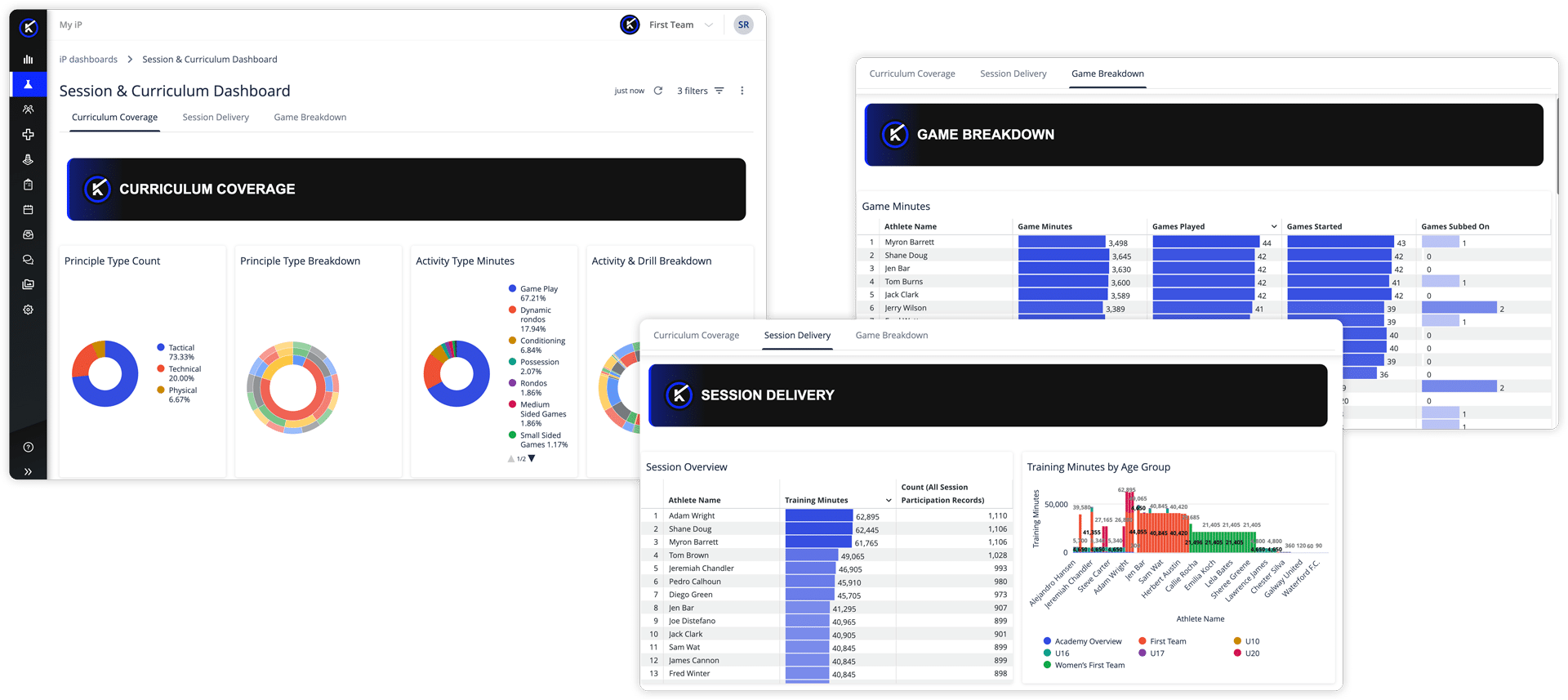
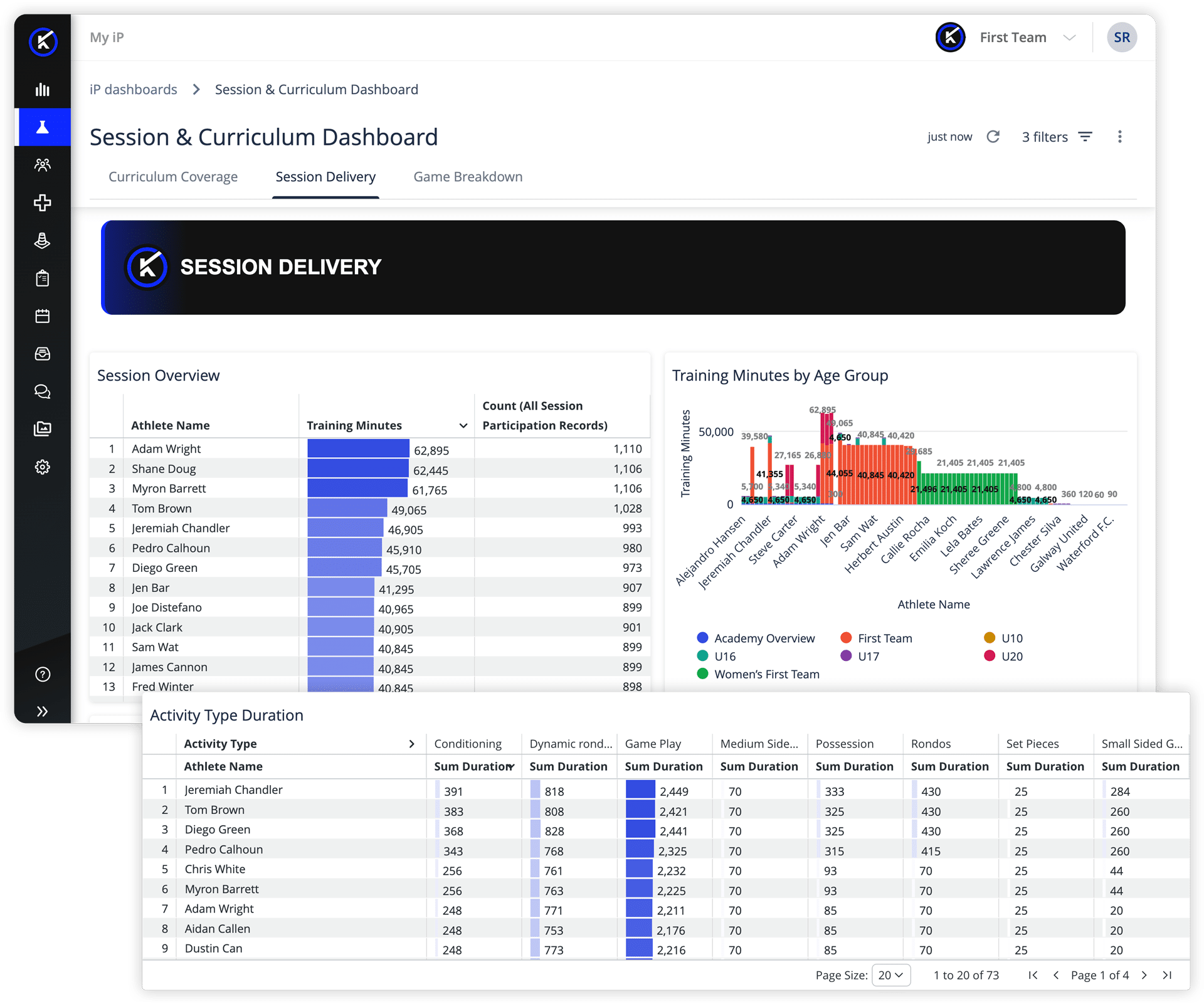
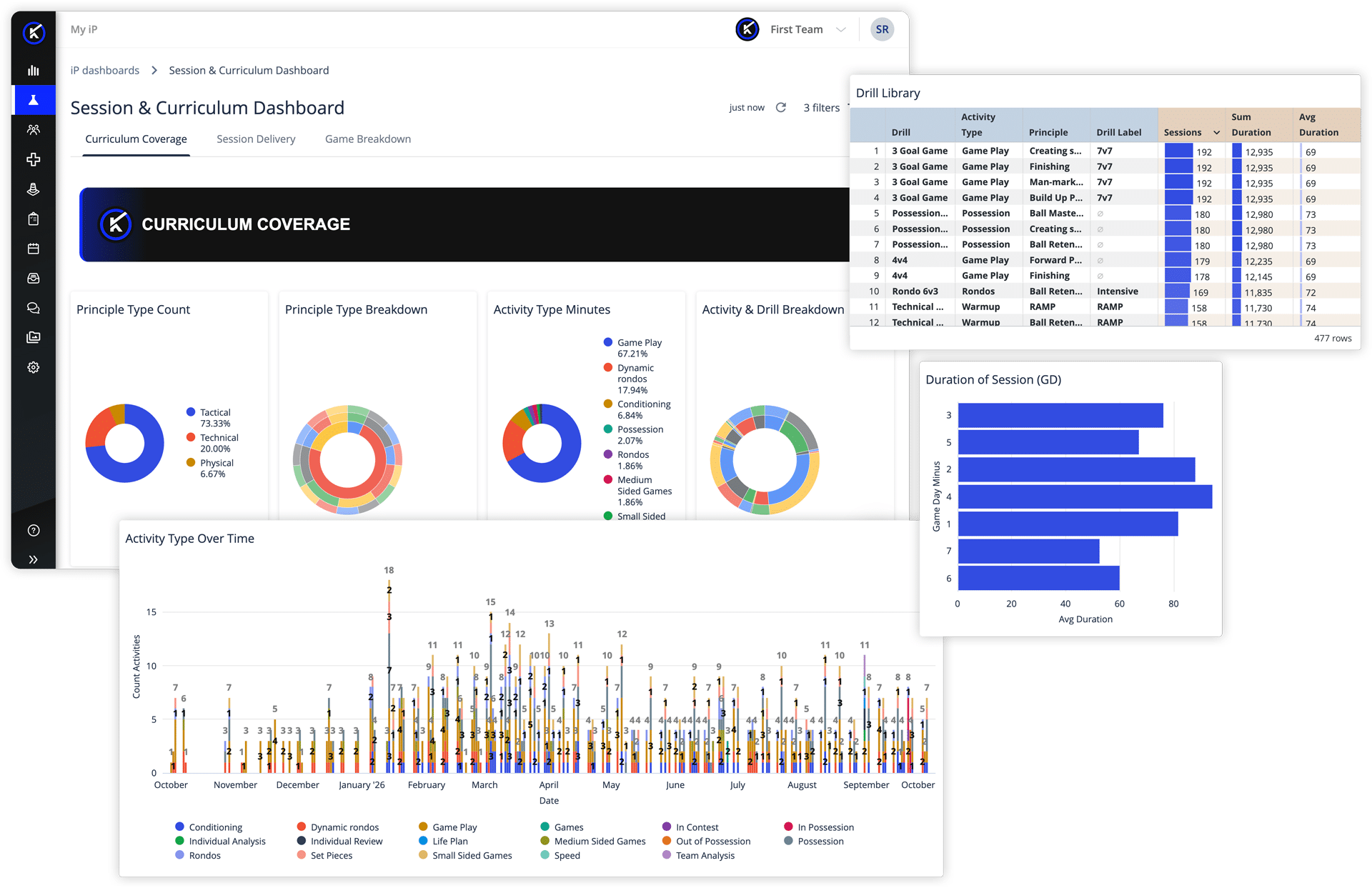
The Session & Curriculum Dashboard in My iP gives academies using the Coaching & Development Solution a starting point for reviewing that delivery.
- Curriculum Coverage shows the principles, activity types, and drills players have worked through.
- Session Delivery adds how training time has been used, down to the components within each drill.
Coaches can review that by squad, time period, or individual player. It moves the conversation from what did we plan to what did we actually deliver. And because that review can happen during the season, staff still have time to decide what needs more attention next.
Review the Individual Player
Academy development is about individual players, not only squads.
A player may move between age groups, miss part of a training block, or join partway through the season.
The same reporting can be filtered to that player to show what they have actually experienced across the curriculum.
That sits alongside wider athlete development workflows, including Individual Development Plans, assessments, and benchmarking.
Connect Development Across Training and Games
Training and games are different parts of player development, but they should not have to be reviewed in separate reports.
The Session & Curriculum Dashboard uses the same squad, player, and time-period filters across Session Delivery and Game Breakdown.
That makes it easier to review:
- What a player worked on in training
- How much training time went into different areas
- How many game minutes they received over the same period
- How that experience changed across the block
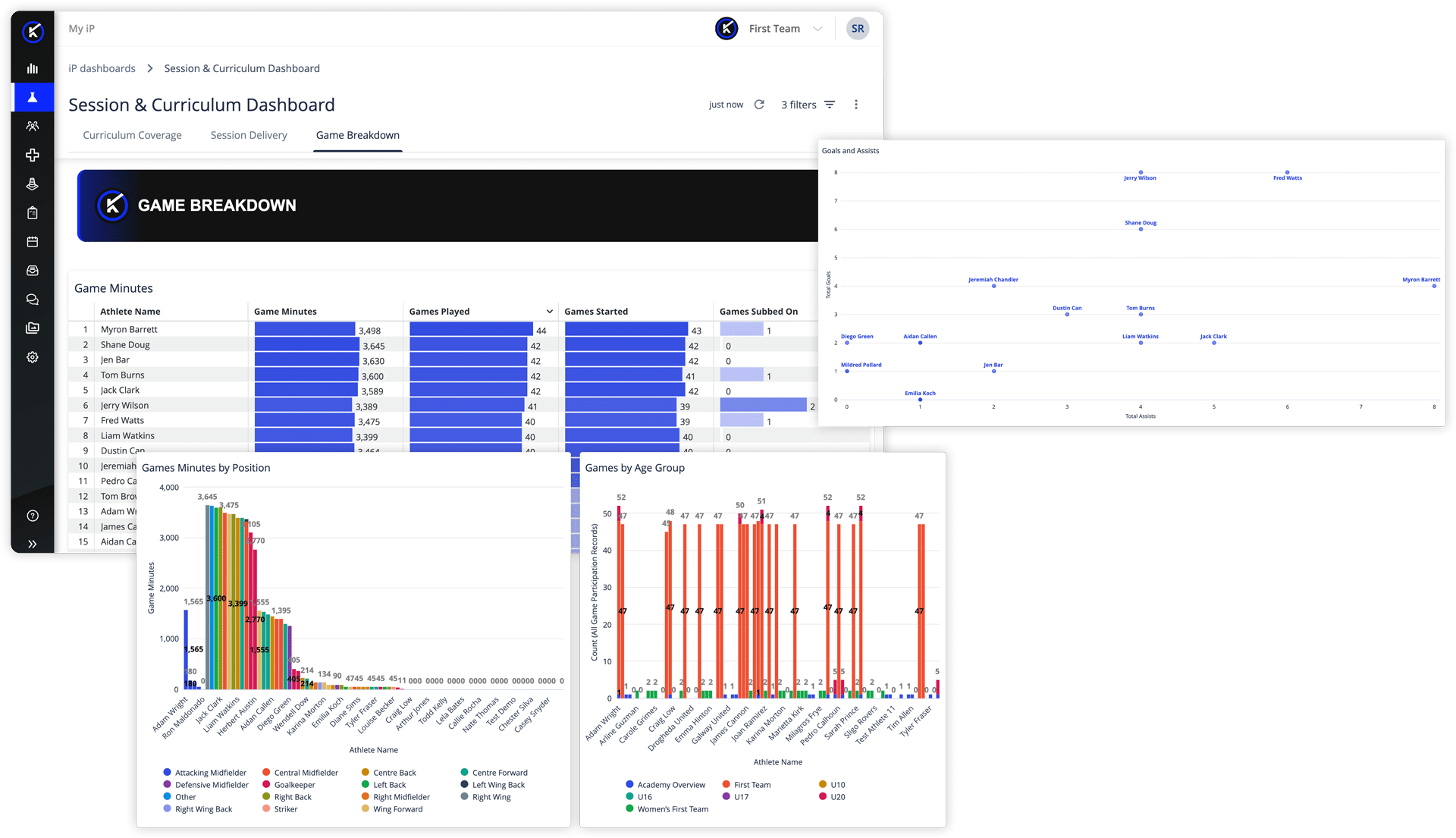
The dashboard does not decide why a player did or did not play. Selection stays a coaching decision.
It puts the training and game information side by side, so staff have more context for the conversation that follows.
Review the Academy, and Evidence the Work
An individual coach needs to understand their squad. A Head of Coaching, Academy Manager, or Technical Director needs to see across the whole pathway.
Using the same curriculum structure across age groups makes it easier to ask:
- Are development priorities being delivered consistently?
- Where is a principle getting more or less attention?
- Is that difference expected for the age group?
- Does a gap show up in one squad or several?
- Where might a closer coaching conversation be needed?
The goal is not to make every squad train the same way.
Different age groups and players have different needs. The value is seeing whether a difference was planned, or whether part of the coaching model has gradually received less attention.
Be Able to Show What Was Delivered
There are also times when an academy needs a clear record of its work.
That may be part of an internal season review, academy standards review, league or federation process, or a handover to new staff.
Curriculum Coverage provides an audit trail of what was delivered that can be reviewed across the academy, by squad, or for an individual player.
This does not determine whether an academy meets a particular league, federation, or licensing standard. Those requirements are set by the organization carrying out the review.
What it provides is a clearer record of what was delivered, without rebuilding a season from individual session plans.
Football Academy Software Checklist
When you evaluate football academy software, look at whether it can:
- Build your academy’s own curriculum, principles, and terminology into the system
- Connect those principles directly to the sessions coaches build and deliver
- Show what was actually delivered across the season
- Track how training time is being used across the curriculum
- Review delivery by squad, age group, time period, and individual player
- Connect Individual Development Plans and assessments to the wider development process
- Review training content alongside game participation
- Compare curriculum delivery across the academy using one reporting structure
- Maintain a record of curriculum delivery across the season
- Give coaches and academy leadership access to the same underlying information
The test isn’t how many features the software has. It’s how much of the development process stays connected once coaches start using it.
One Connected Coaching and Development Workflow
The Coaching & Development Solution in iP: Intelligence Platform connects the work that shapes player development across the academy:
- Development principles and curriculum: define the coaching model and development priorities that guide the pathway.
- Sessions and activities: coaches enter the session against those priorities before it happens, then update it afterwards to record what was actually delivered.
- Individual development plans: give players clear development objectives and actions over time.
- Assessments and benchmarking: review progress against the standards that matter to the academy.
- Growth and maturation: add physical development context where it matters for young players.
- Curriculum and training reporting in My iP: see what was delivered, how training time was used, and how delivery looks across squads, age groups, and individual players.
The value isn’t having all of those. It’s being able to connect them.
More Than a Session Planner
Football academies do not only need somewhere to build training sessions.
They need to know whether the development model they set is reaching the players it was designed for.
That means connecting the curriculum to the coaching week, the coaching week to the individual player, and the work delivered to the reporting academy leaders use to make decisions.
The result is a clearer view of what coaches delivered, what players experienced, how closely that matches the academy’s model, and what needs attention next.
That is what connected football academy software should look like: more than a session planner.
Contact us to see how it can fit your academy’s curriculum and coaching model.