Most sports organizations don’t have a data problem.
They have more data than ever, from GPS and testing to wellness, medical records, evaluations, and third-party systems.
What they often lack is a common structure across those sources.
When data from multiple vendors and workflows isn’t standardized and aligned, everything downstream becomes harder. Reporting breaks. Stakeholders question outputs. And someone inside the organization is left trying to bring it all together, exporting files, cleaning inconsistencies, reconciling event types, and stitching together reports just to keep the week moving.
That is what data health really is in sport. Not just collecting information, but creating a consistent, trusted foundation that every department can rely on.
Why data health matters more than ever
Data health isn’t a one-time cleanup task. It’s an operating standard.
When data quality slips, the impact compounds:
- Issues that should be caught early become manual fixes later
- Dashboards become harder to trust
- Teams spend more time validating information than acting on it
- Confidence drops across departments
- Spreadsheets and side trackers reappear, creating the same risks with less oversight
The goal isn’t to collect more data. It’s to give teams a clearer way to see, check, and correct the data they already rely on—consistently, week after week.
Data health is an adoption problem in disguise
Adoption rarely fails because staff don’t believe in data. It fails because the workflow becomes unsustainable.
When teams don’t fully trust what’s in the system, they build safeguards around it:
- Keeping manual trackers “just in case”
- Exporting data before it’s structured
- Duplicating entry to avoid losing context
- Relying on individuals to reconcile differences
Over time, the platform becomes harder to rely on. Not because of a lack of effort, but because the underlying data foundation isn’t stable.
Data health breaks that cycle. When the data is trusted, the platform becomes the source of truth. And when the platform becomes the source of truth, adoption follows.
Data health is a two-layer challenge
Most teams treat data quality as something they deal with at the end, when reporting is built. But data health is really a challenge at two points in the workflow, and strong data health depends on addressing both.
The first layer is ingestion, when data enters the platform. This is where inconsistencies quietly appear: identifiers that don’t match, missing context, device anomalies, misaligned values. If issues are not caught here, they flow downstream into everything built on top of them.
The second layer is ongoing visibility, the ability to review the integrity of your data over time, before you rely on it for reporting and decisions. Even with clean ingestion, data drifts: a source stops syncing, a case is left open, a season is misclassified.
iP: Intelligence Platform addresses both through the Data Health experience. Data quality is strengthened at the point of intake in iP, then surfaced for ongoing review in the Data Health Check Dashboards in My iP. Together, those two layers turn data health from a manual responsibility into a platform capability.
Why a unified system is critical for data health
Data health becomes exponentially harder when information lives across separate applications. Even with the best intentions, teams end up managing different versions of the truth: different event contexts, inconsistent naming, and inconsistent reporting outputs depending on where the data originated.
iP: Intelligence Platform is built to eliminate that fragmentation. Not as a collection of separate modules, but as one system: one login, one structured data foundation, and one shared environment where performance, medical, coaching, and operations workflows stay connected.
That means a single training or competition event holds the full picture: planned content, participation, lineups, device data, RPE, medical notes, and linked injuries, all in one record.
When coaches, medical, sports science, and performance staff work from the same foundation, data health becomes easier to maintain, because the organization isn’t constantly reconciling differences between disconnected inputs and disconnected outputs.
Layer one of the Data Health experience: data quality at ingestion
Centralizing data is only half the equation. The bigger challenge is keeping it clean and consistent for everyone relying on the platform.
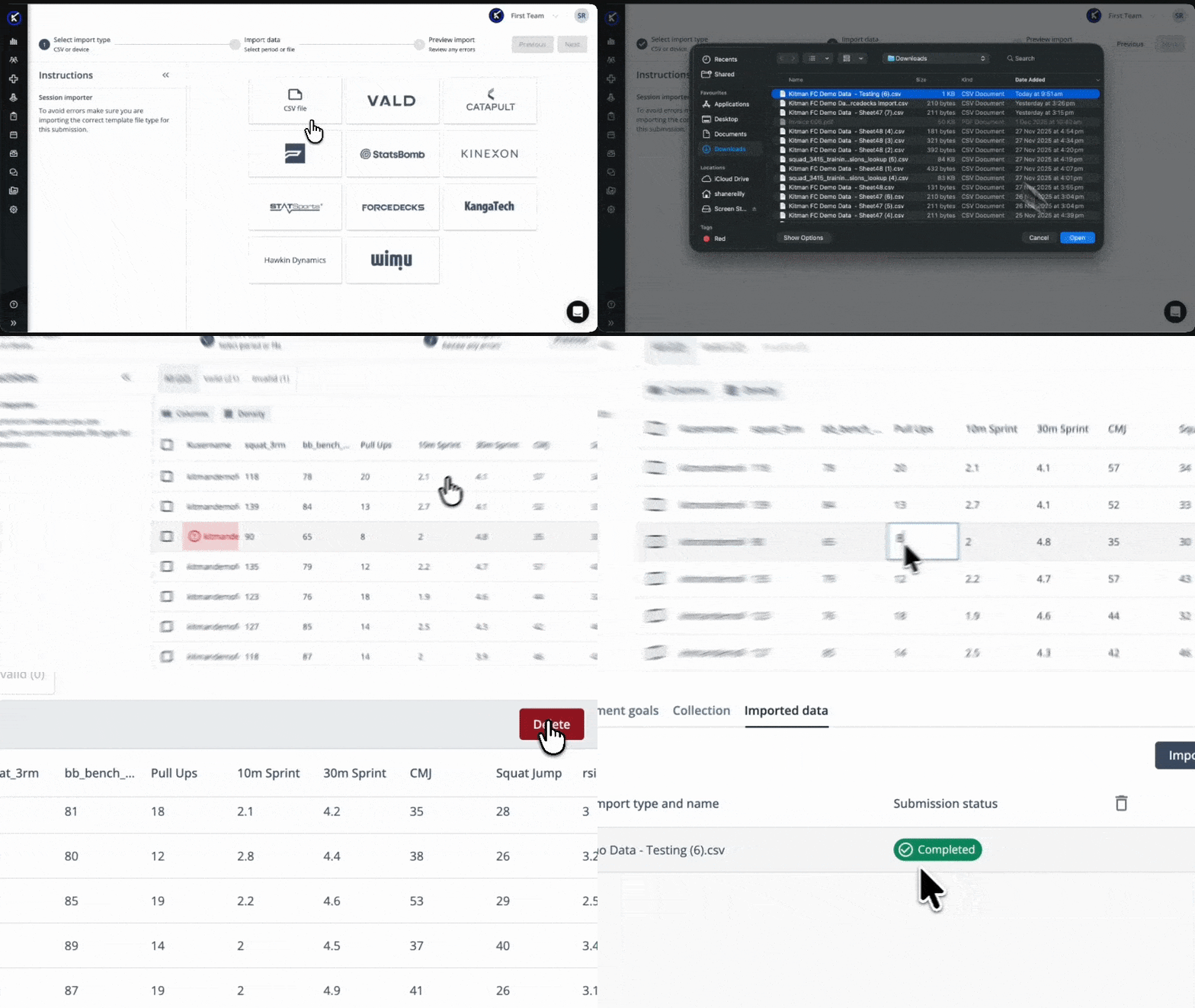
That’s why iP is designed to improve data quality at the point of intake, making ingestion transparent rather than a “black box.”
Teams can review and validate incoming data, correct issues directly within the platform, and ensure that values, identifiers, and event classifications are accurate before they flow into reporting and dashboards.
This includes automatically linking incoming device and third-party data to the correct training or competition event in the calendar, so planned context and actual output live in a single, consistent record rather than across duplicate or misclassified entries.
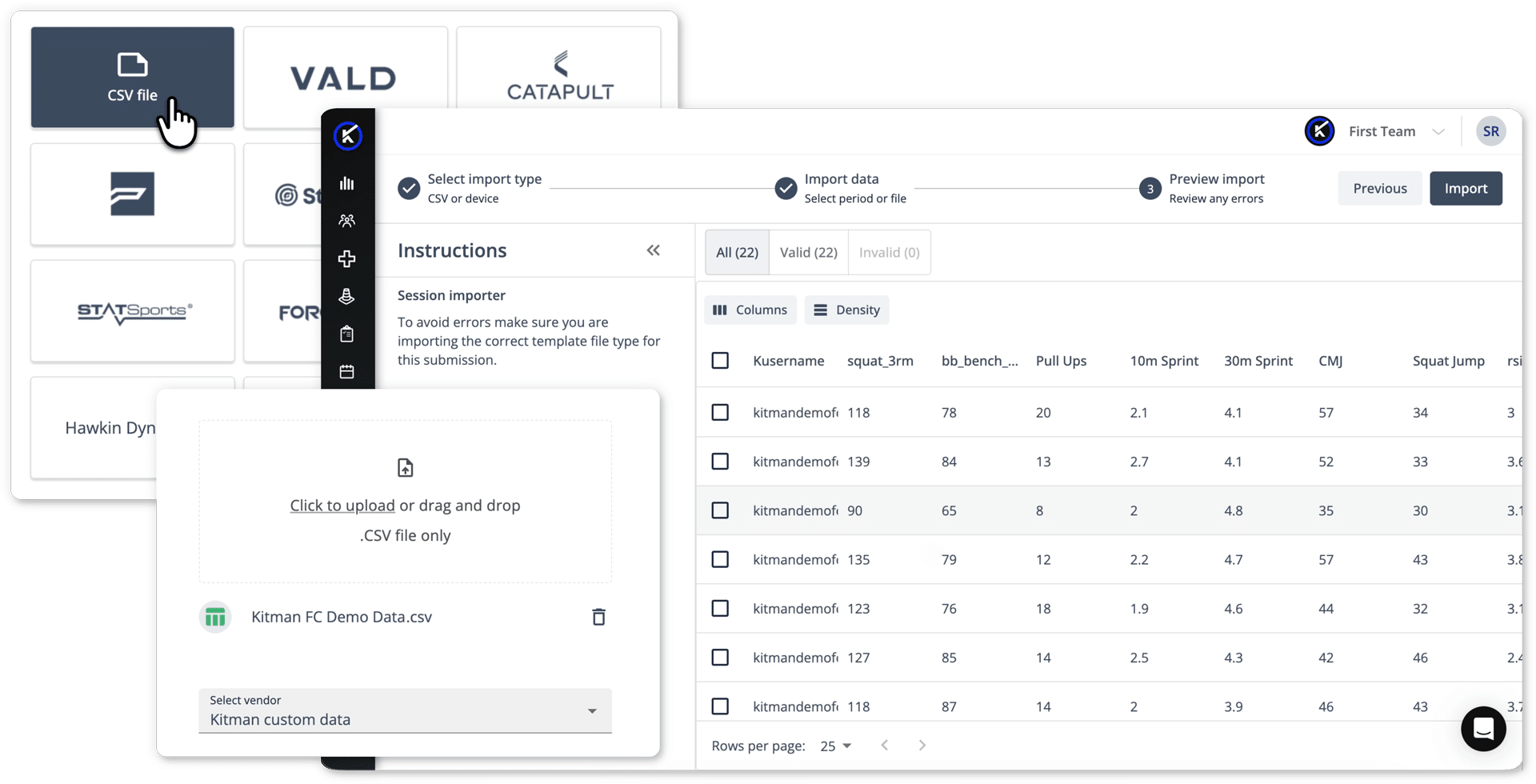
By strengthening the ingestion layer, iP helps prevent many common data quality issues before they scale across departments.
For guidance on choosing between a direct integration and a manual upload, see Direct Integrations vs. Manual Uploads: Why Data Intake Matters in iP.
Layer two of the Data Health experience: ongoing visibility in My iP
Even with strong ingestion workflows, organizations need ongoing visibility into the quality of their data over time.
This is, in effect, observability for your data: the ability to see the quality & completeness of what you’re collecting, how records are labeled, and whether the connections between events, athletes, and metrics hold up, before anything downstream depends on them. It’s the quiet discipline behind every trusted report.
That’s where the second layer comes in, the Data Health Check Dashboards in My iP. They give teams visibility into the integrity of their data before they rely on it for reporting and decision-making, surfacing logical inconsistencies and anomalies that warrant a closer look.
Each dashboard focuses on a different part of the data foundation:
- Athlete Data Health Checks review athlete master data, surfacing duplicates, missing or questionable dates of birth, unmapped positions, and season coverage issues
- Game Data Health Checks review fixture data, surfacing competition mapping, duplicate games, results, home/away, participation, and game-minute issues
- Medical Data Health Checks review injury records, surfacing preliminary cases, missing clinical fields, event-linking issues, and unresolved or severe time-loss cases
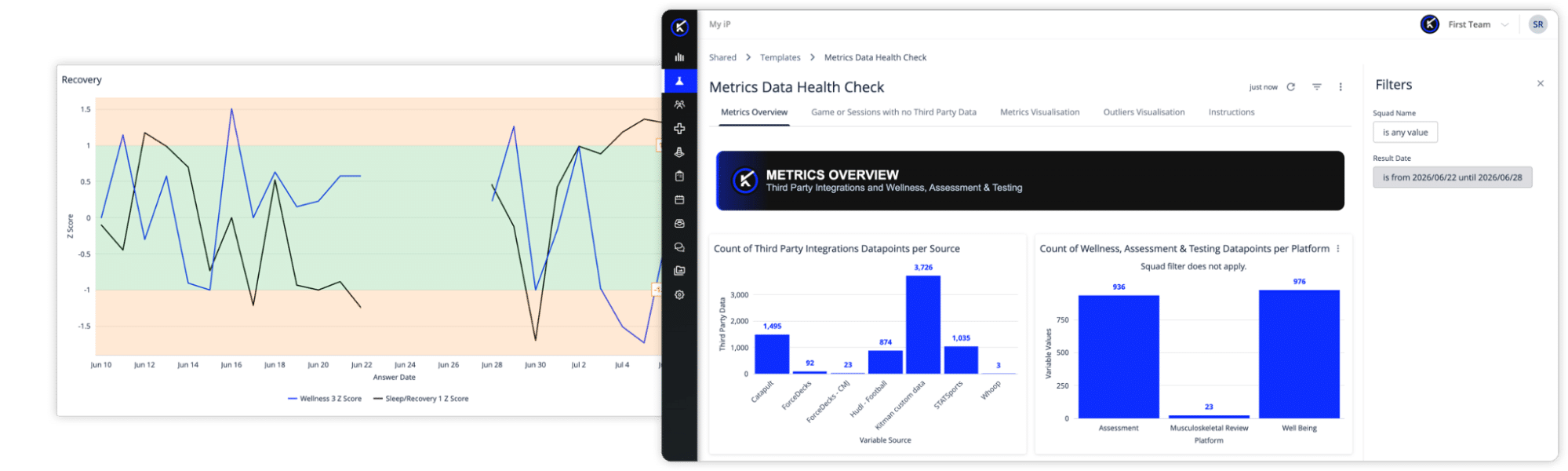
- Metrics Data Health Checks review connected performance data, surfacing integration coverage gaps, under-reporting variables, and metric outliers or drift
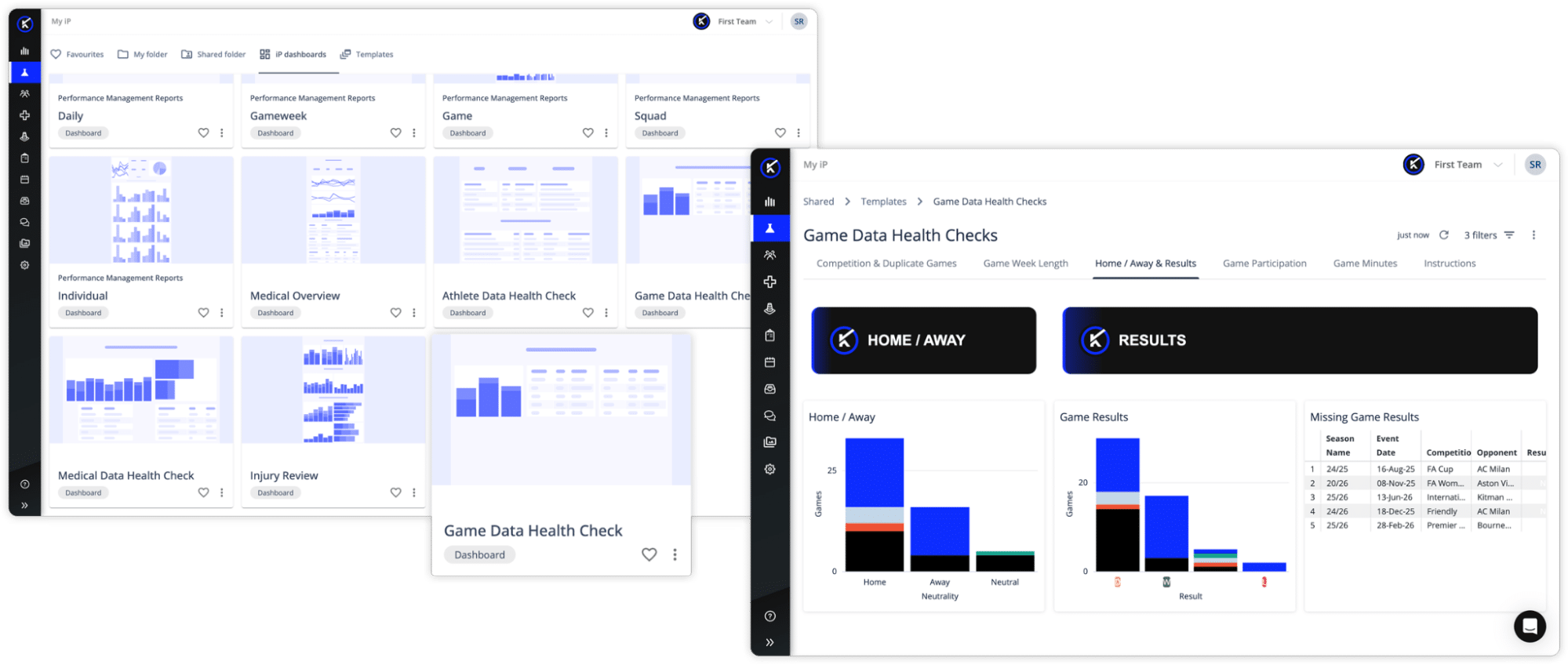
Availability of some checks depends on the Solutions enabled in iP.
These checks don’t “fix” data automatically. They surface areas that may require review, giving teams the opportunity to validate or correct values directly in the platform.
The result is proactive confidence: teams can review flagged items, address what needs attention, and move into dashboards knowing the underlying data has been examined.
Together, the two layers of the Data Health experience prevent issues where possible and surface them clearly when they require human judgment.
For the routine that turns these checks into a habit, see The Data Health Playbook.
The outcome: trust, confidence, and momentum across departments
When data health is built into the platform experience, the value extends across the organization.
- Performance staff get more reliable insight.
- Medical teams work with fewer gaps.
- Coaches gain more confidence in what they are seeing.
- Operations staff spend less time working around inconsistent records.
The organization gains something even more important: a platform people can trust.
That foundation matters even more as teams look toward AI. Predictive models are only as strong as the data behind them. Gaps, outliers, and mislabeled records do not just weaken today’s dashboards. They undermine anything built on top of them.
Clean data is what makes reporting trustworthy now—and what makes future AI models possible.
Put this into practice. The Data Health Playbook turns the two layers into a routine your staff can run: what to agree before the season, what to check each time new data arrives, and what to review on a schedule, with a named owner and backup for every check.
New to iP? Contact us to see how iP makes clean data easier to maintain across every department.